

Articles
Category Article Show all
-
Risk Assessments: Better Together
Share Risk Assessments: Better Together on Facebook Share Risk Assessments: Better Together on X (formerly Twitter) Share Risk Assessments: Better Together on Linkedin Email Risk Assessments: Better Together linkThis article presents general observations from Auckland Transport’s Temporary Traffic Management (TTM) advisory team. It supports continuous improvement within the temporary traffic management industry and does not reference any specific individual or organisation.
As we move from the Code of Practice for Temporary Traffic Management (CoPTTM) to the New Zealand Guide to Temporary Traffic Management (NZGTTM), it is important to reflect on how different Persons Conducting a Business or Undertaking (PCBU) may naturally focus on certain risk categories. This tendency is influenced by factors such as resources, cost, time, reputation, and health and safety, all of which shape effective riskContinue reading
This article presents general observations from Auckland Transport’s Temporary Traffic Management (TTM) advisory team. It supports continuous improvement within the temporary traffic management industry and does not reference any specific individual or organisation.
As we move from the Code of Practice for Temporary Traffic Management (CoPTTM) to the New Zealand Guide to Temporary Traffic Management (NZGTTM), it is important to reflect on how different Persons Conducting a Business or Undertaking (PCBU) may naturally focus on certain risk categories. This tendency is influenced by factors such as resources, cost, time, reputation, and health and safety, all of which shape effective risk management strategies.
NZGTTM requires all parties to consider risks for all recipient groups, while CoPTTM provided broader, systemic coverage for three main parties/elements at risk: network functionality, road users, and workers. Individual perceptions of risk are shaped by past experiences, knowledge, focus, and other factors, which can lead to blind spots. Similarly, different PCBUs may prioritise certain risks over others, as observed in risk assessments and worksite TTM practices.
Common Risk Assessment Challenges
Many traffic management plans submitted as NZGTTM applications do not adequately consider risks before implementing controls. Assessments are often missing, incomplete, or do not clearly define net risk after controls. Sometimes, risks are only evaluated after mitigations are chosen, without addressing any transferred or residual risks. Changes may resolve one issue but create another, and there is often little insight into why specific controls and trade-offs were selected. Risk matrices frequently overlook details, such as steel plates present during certain phases and considerations for unattended states, especially regarding psychological impacts on road users. Excessive false alarms from unnecessary temporary speed limits or warnings can decrease compliance network-wide, undermining the effectiveness of safety installations where they are genuinely needed.
Importance of Comprehensive Planning
Effective planning, including thorough risk assessment and temporary traffic management mitigations, requires collaboration among project management, health and safety, construction planning, traffic engineering, and stakeholder engagement. This ensures outcomes that are safe, coordinated, and efficient.
Risk Focus Tendency Matrix
The following conceptual matrix, developed from aggregated observations, highlights typical focus areas for different elements assessing risk. It is designed to prompt reflection and discussion, not to serve as a definitive guide for any specific situation or PCBU group. Note that Auckland Transport's functions as RCA, Principal, and Advisory may not all be represented.
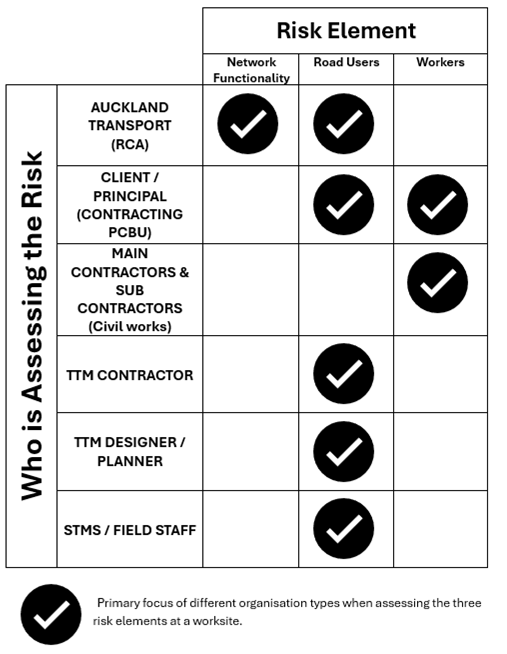
The table has been developed as a generalised summary from observations of general behaviours and outcomes by the AT RCA Temporary Traffic Monitoring Team (TTM Advisors) and shows the observed natural focus areas for the different organisations and individuals when assessing risk. We have included it here for reflection and to help us all recognise that it is unlikely that one individual working alone will be able to definitively assess all risks in any specific situation.
Why These Patterns Matter
This matrix demonstrates the necessity of a multi-party approach—the 3Cs: consult, cooperate, and coordinate. Each PCBU’s natural focus can create gaps that others must help address. For instance, a presentation at the 2024 Tarmac Conference illustrated how pedestrian exposure to overhead work zones varies. CoPTTM might call for closing a large section of footpath for the day, while NZGTTM could allow for a more tailored, moving closure that aligns with the location of overhead works. This reduces net risk by minimising site footprint and improving behavioural compliance and network satisfaction. A risk-based approach compels all PCBUs to consider all parties at risk, not just their usual areas of concern. This matrix is just one example for how different parties might have primary or secondary concerns and is for illustrative purposes.
Characteristics of Comprehensive Traffic Management Plans
Traffic management plans (TMPs) that demonstrate a more thorough risk consideration show that PCBUs actively work to identify and address areas needing more attention through:
- Full cross-functional risk consultation involving all PCBU parties (the 3Cs).
- Structured risk assessments that systematically address all three elements/parties at risk, developing solutions using the hierarchy of controls before determining the final approach, making these assessments actionable for those involved at relevant times.
- Measured, digestible risk matrices tailored to specific works, with practical applications for onsite parties and clear protocols for sharing risk information across PCBUs.
- Defined assurance and monitoring actions, roles, and responsibilities to track effectiveness across all risk areas, fostering mutual understanding of chosen approaches and setup rationale.
Auckland Transport’s Role as Road Controlling Authority (RCA)
As RCA, Auckland Transport reviews applications through a holistic lens, considering all risk holder categories and elements. Key evaluation principles have emerged as understanding of the risk-based approach has evolved. These principles reflect a commitment to worker and public safety and network integrity and are applied in line with national guidance and regulatory frameworks.
Towards Actionable Risk Assessments
Adopting ISO 31000 Risk Management Principles can guide improvement:
- Integration: Embed risk management in all organisational activities and decision-making.
- Structured and comprehensive: Take a systematic approach that addresses all types of risk. Note that risk registries are not risk assessments; avoid overloading assessments with too many items to maintain clarity.
- Customized: Tailor risk management frameworks to the organisation’s context and objectives.
- Inclusive: Involve relevant stakeholders to incorporate their knowledge and perspectives.
- Dynamic: Monitor and review risks continuously, recognising they change over time.
- Evidence-based: Base risk management on the best available information.
- Human and cultural factors: Acknowledge the significant influence of behaviour and culture on risk management effectiveness.
Moving Forward Together
Recognising natural focus areas—and where some risks may be overlooked—underscores the importance of collaboration. A risk-based approach encourages PCBUs to:
- Identify their own focus areas and potential blind spots.
- Consult with others to uncover overlooked risks.
- Coordinate systems for monitoring effectiveness across all parties.
- Communicate consistently and in a targeted way as risks evolve throughout a project.
As the transition continues, understanding will develop further, and many organisations are already making progress. By embracing the principles of consultation, cooperation, and coordination (the 3Cs)—in line with WorkSafe and the Health and Safety at Work Act—we can work towards meeting our duties and reveal risks critical to others.
With greater flexibility comes increased responsibility. This is how safer, more resilient outcomes can be created together.