Midtown Access

Share Midtown Access on Facebook Share Midtown Access on Twitter Share Midtown Access on Linkedin Email Midtown Access link

Trial changes in Midtown to keep our city moving

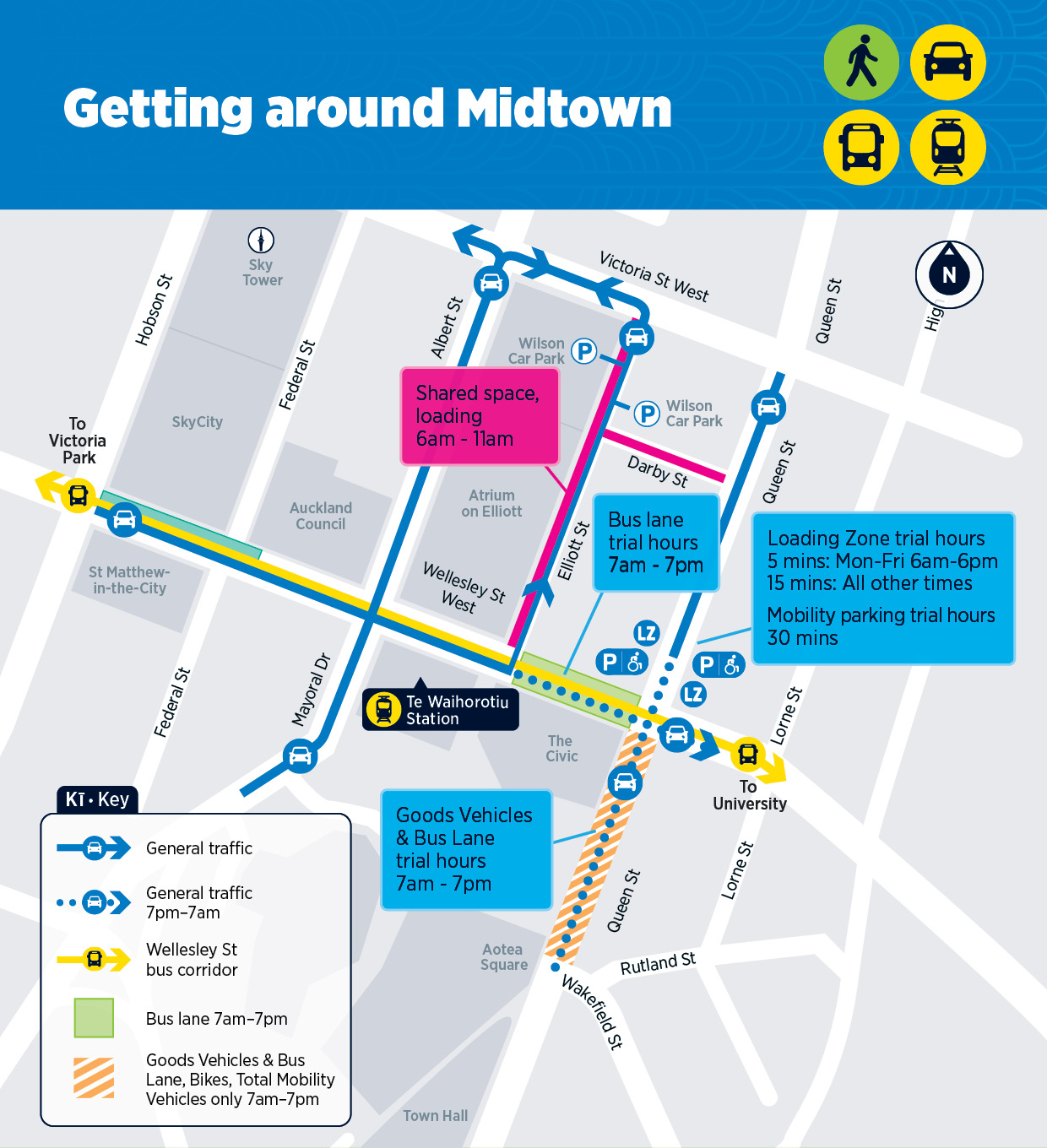
Auckland’s midtown is getting ready for City Rail Link (CRL). To make sure buses run reliably, people can get to their destination safely, and support the soon to be busiest transport hub in New Zealand, we’re trialling a set of easy‑to‑understand access changes in the Aotea / midtown area. These important adjustments aim to balance movement and access for residents, visitors and businesses while the city centre transitions to its CRL “day one” network.

What is changing to how I get around?

On Queen Street, we’ve identified an opportunity to review the Authorised Vehicles Only (AVO) zone, including allowing Total Mobility registered vehicles to use the AVO. We are also looking to improve mobility parking and loading and servicing in certain areas on Queen Street.

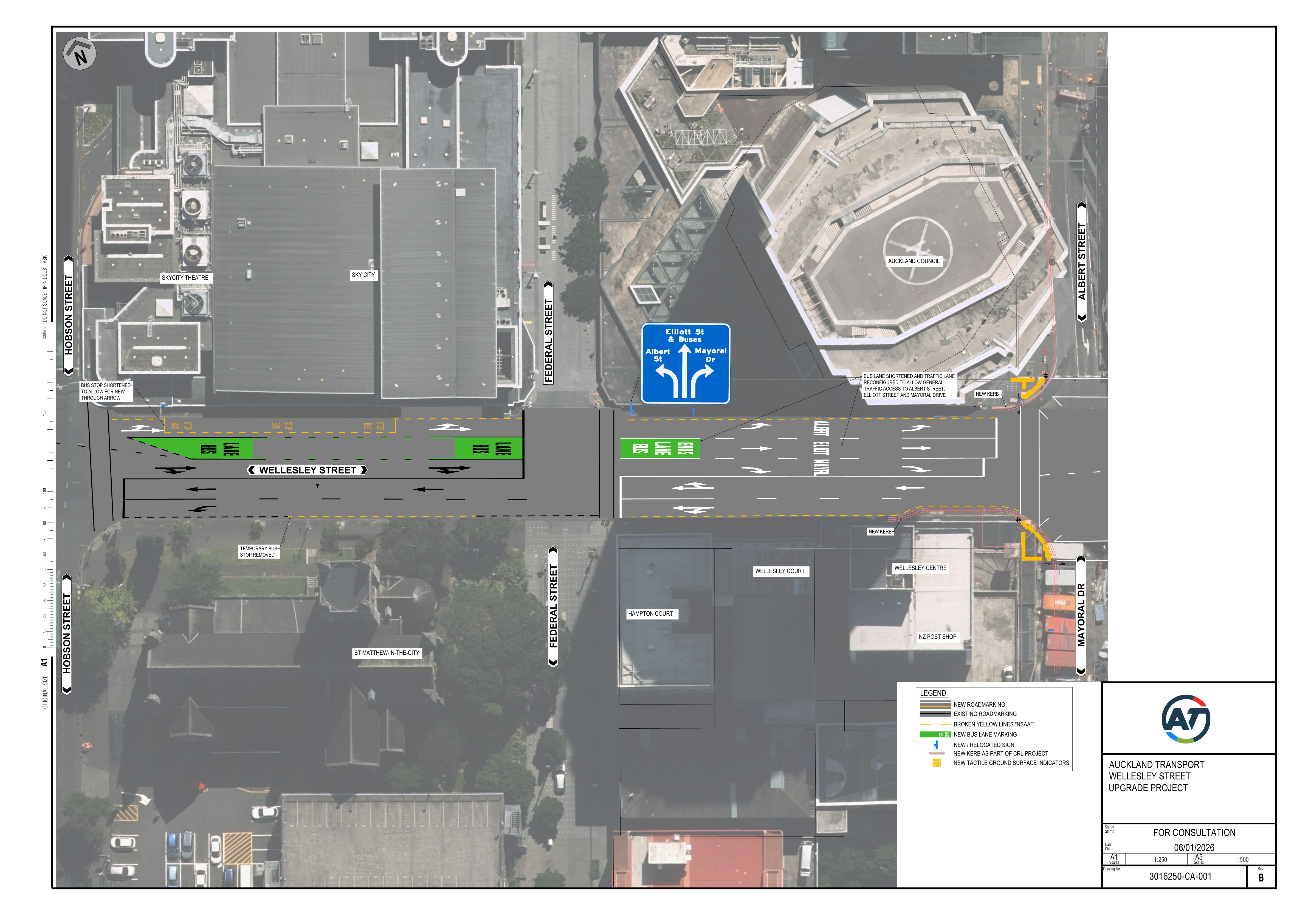
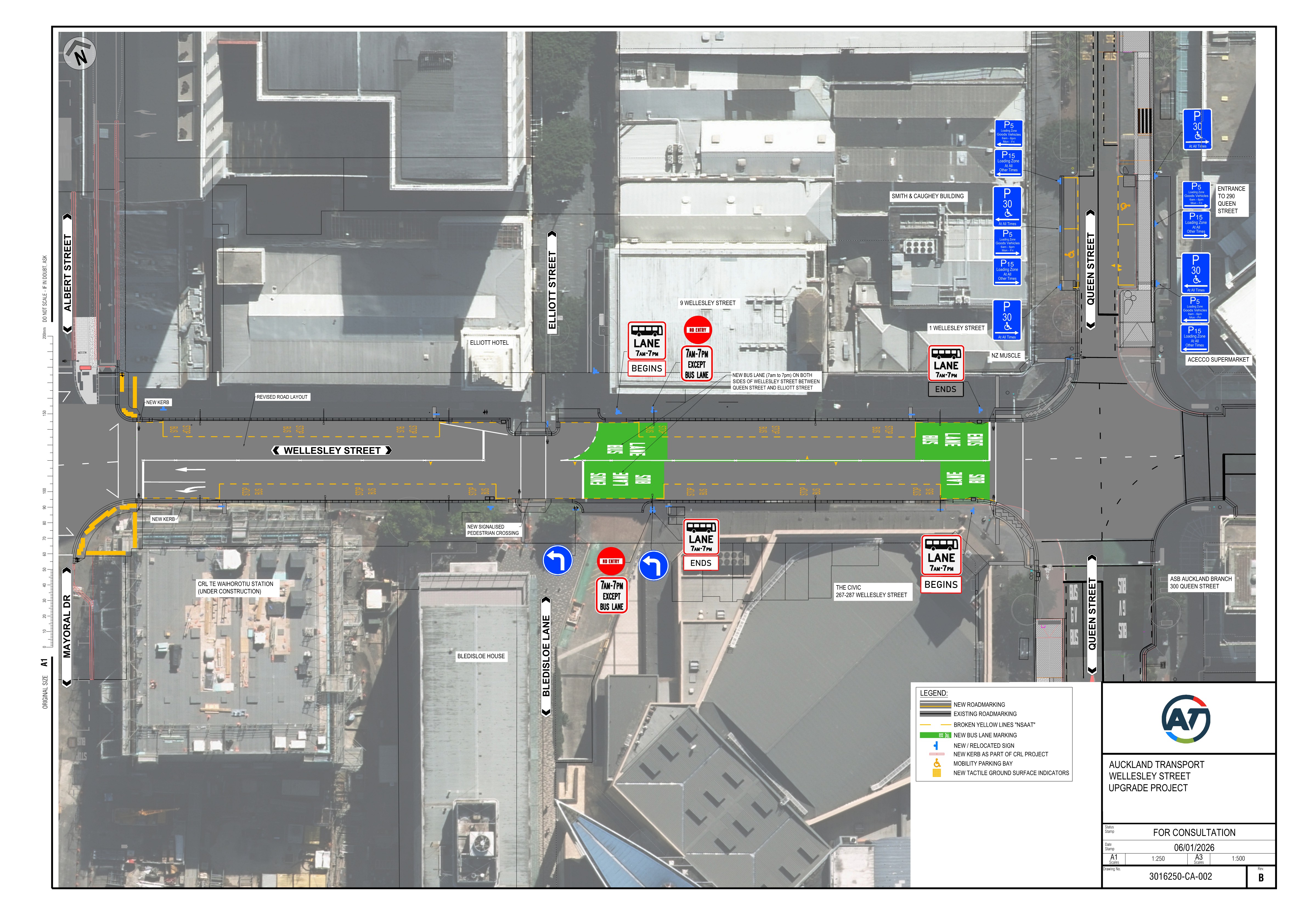
On Wellesley Street - we’re introducing bus lanes on both sides from 7am to 7pm between Elliott Street and Queen Street to enable faster, more reliable journeys. In addition, we will be installing new signs and road markings, and the temporary bus stop outside St Matthew-in-the-City will be removed.

We’re bringing all the changes together in one integrated plan and implementing them at the same time mid April 2026. These changes will be evaluated and adjusted during a 2 year trial. We’re timing the changes so we’re ready for the opening of City Rail Link (CRL) in 2026.

What's Happening on Wellesley Street?

Wellesley Street upgrades are taking shape with new bus shelters, wider footpaths and improved pedestrian crossings. Once CRL is open, there will be 17,500 bus passengers travelling along Wellesley Street each day and more pedestrians going in and out of the new Te Waihorotiu CRL Train Station. Further changes are needed to enable Wellesley Street to become a new gateway to the city as well as a thriving pedestrian and entertainment destination.

From Mid April 2026;

  • We’re introducing bus lanes on both sides of Wellesley Street between Elliott Street and Queen Street. These lanes will prioritise buses from 7am to 7pm daily to enable faster, more reliable journeys.
  • From 7pm to 7am daily, these bus lanes are open for general traffic to reach Queen Street when bus travel is less frequent.
  • We’re removing the temporary bus stop outside St Matthew-in-the-City as this was only needed during construction.

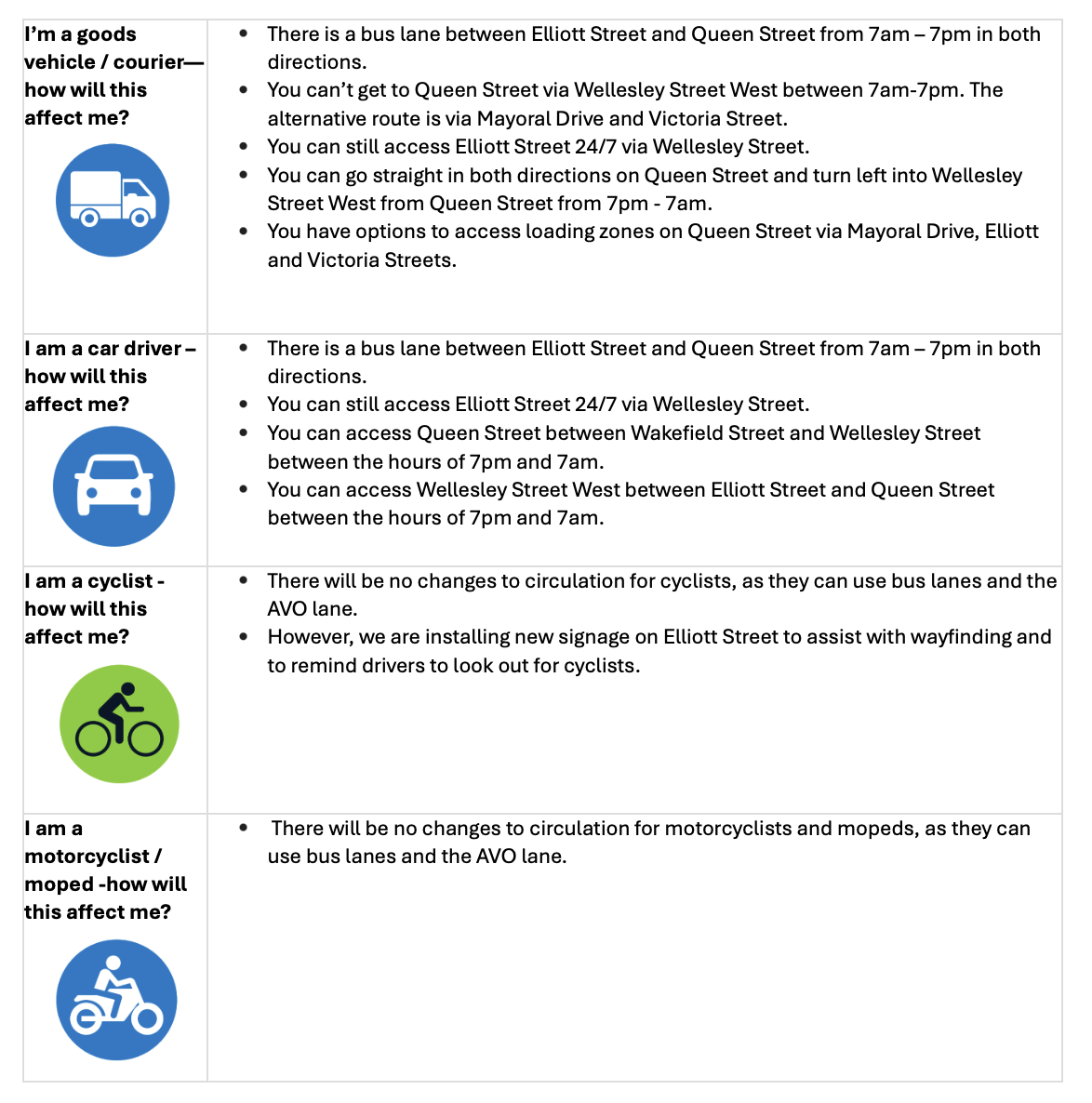
During 7am and 7pm only buses, bikes, motorbikes and mopeds can use the bus lanes.

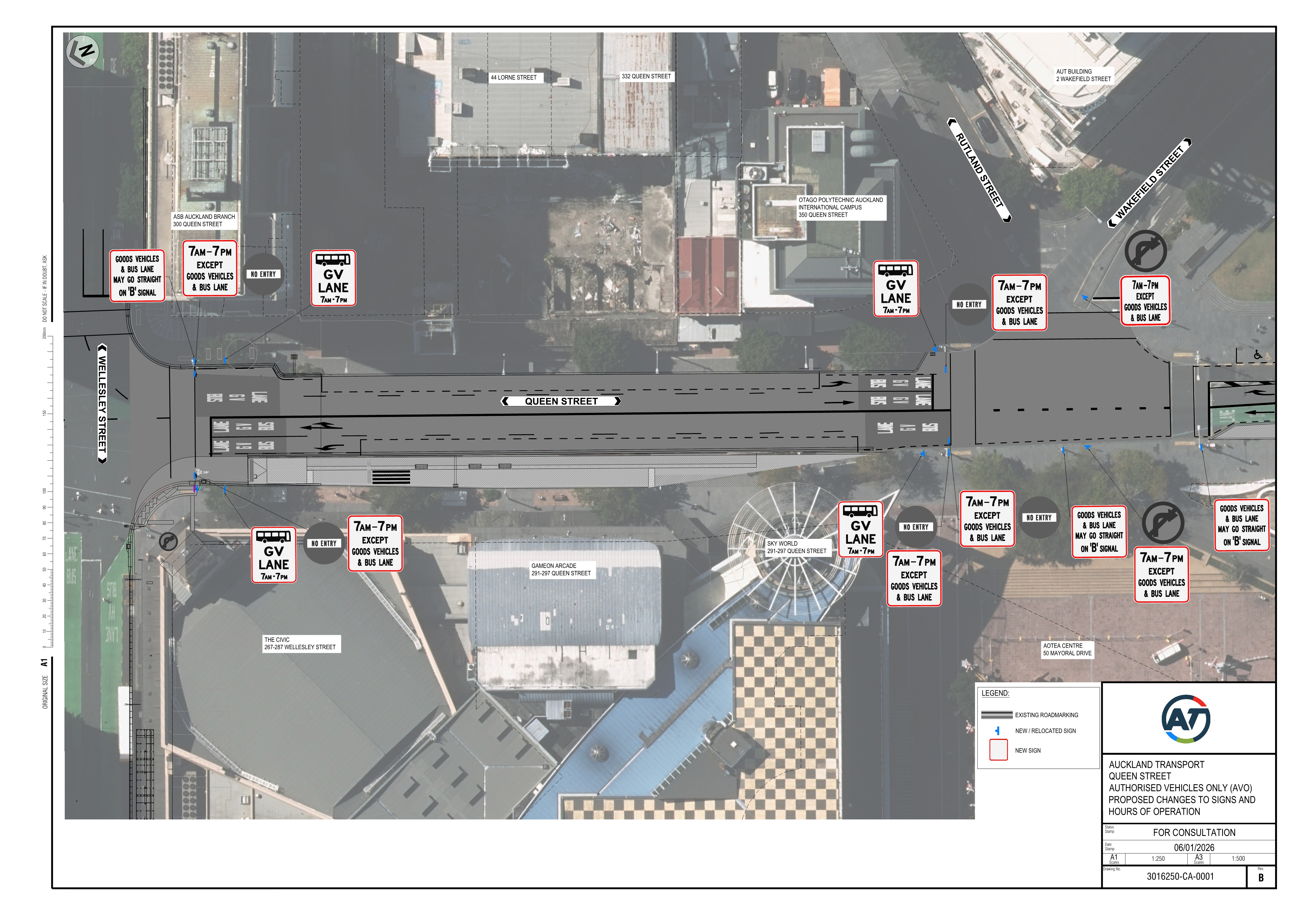
Take a closer look at the drawings here

What is Happening on Queen Street?

Authorised Vehicles Only (AVO) Zone

The length of Queen Street between Wellesley Street (Civic Theatre) and Wakefield Street (Town Hall) is currently operating as a 24/7 Bus Lane and Authorised Vehicles Only (AVO) lane. Authorised Vehicles include buses, goods vehicles, cycles, mopeds, motorcycles and emergency services. This means private vehicles, taxis, and car share services are not permitted in this part of Queen Street. The AVO successfully reduced through-traffic on Queen Street, which led to improved bus reliability while supporting efficient delivery of goods.

Albert Street and Mayoral Drive reopened on 29 November 2025 after eight years, allowing nearly 900 buses to return to these routes each day. This has shifted 447 buses in each direction off Queen Street, where they had been rerouted during construction. With fewer buses operating on Queen Street, we now have the opportunity to review the operation of the AVO.

AVO Hours will change from 24/7 to 7am–7pm

To support better access, the operating hours of the AVO will change from 24/7 to 7am–7pm, 7 days a week. After 7pm, all traffic will be able to use Queen Street between Wakefield Street and Wellesley Street. This supports night-time activities and creates a safer, more accessible city in the evenings. The AVO hours of 7am – 7pm match the Wellesley Street bus lane hours – allowing traffic to move between Queen Street and Wellesley Street.

Making it easier to get around

Our goal is to make city navigation simpler. We’re improving signage and changing traffic lights to make it easier for everyone to understand who can use the AVO lane and when.

Making it easier for people with mobility access needs

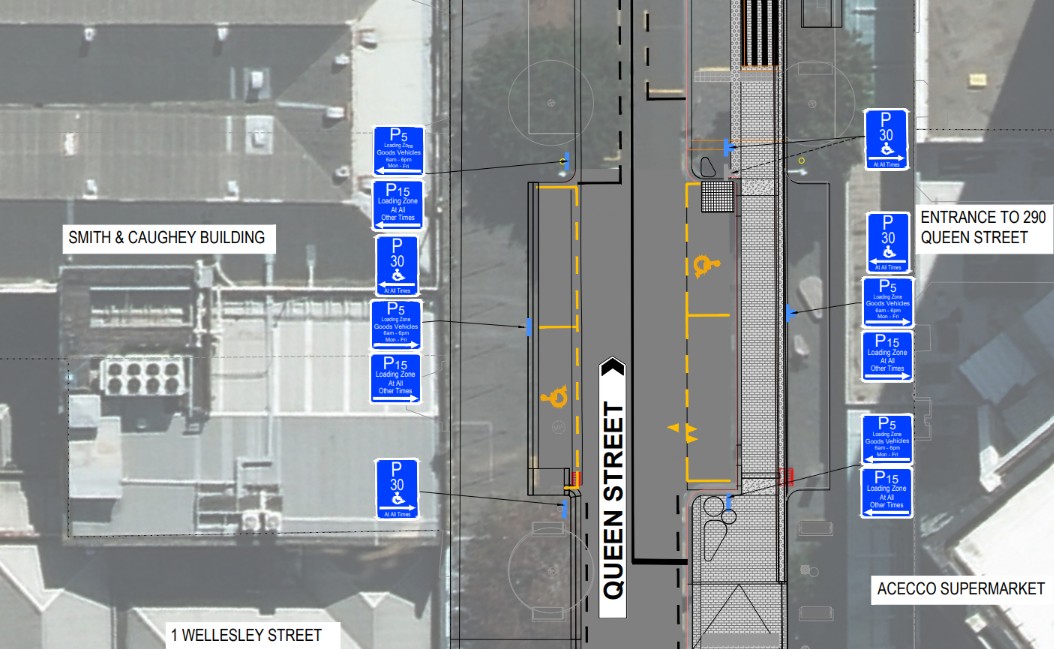
Total Mobility is a New Zealand wide scheme that supports people with mobility access needs to travel by offering subsidised fares on participating taxis. As part of the changes, Total Mobility Registered Vehicles will now be permitted to use the AVO during its revised operating hours (7am–7pm, 7 days a week) to access mobility parking on Queen Street — a positive step towards improving accessibility. Information about the new AVO access will be shared with registered operators. To support accessibility in the city centre, a new mobility parking space is being created on Queen Street, just north of Wellesley Street (outside 290 Queen Street).

Take a closer look at the drawings here

Loading Zone Changes

The timing of the existing Loading Zone (LZ) spaces on both sides of Queen Street—just north of Wellesley Street, outside Acecco Supermarket and the Smith & Caughey building—will be adjusted. These changes in time will align with the majority of LZ times in the city centre, at 5 minutes (Monday to Friday, 6am to 6pm), to increase turnover and improve availability for service vehicles during busy periods. After 6pm on weekdays and throughout weekends, loading and pick-up/drop-off activities become a higher priority. To accommodate this, the vehicle loading time will be extended to 15 minutes.

Take a look at the drawings here


These changes are being delivered as a trial

We’re taking a pragmatic and balanced approach to reducing obstacles for visitors and businesses and residents, supporting key destinations and night time activities, while actively monitoring changes and adapting where we need to. These changes are being delivered as a trial under the Land Transport Rule: Streets Layout 2023. As these changes are implemented, we’ll monitor the network to see how it is working.

The trial of these changes will last for up to two years, allowing us to learn how all forms of transport work together and where adjustments may be needed. The two-year timeframe allows for meaningful input from everyone and enables us to make any necessary changes before setting permanent hours and signage.

We’ll be collecting traffic data and capturing feedback from businesses and road users. The trial area is shown on the map as a black dotted line. We can make changes in the first few months if we need to. If the data shows that the increase in traffic is delaying buses or reducing pedestrian amenity on Queen Street we can make timely adjustments to enable reliable buses and a positive experience.

The engagement will be delivered under the NZ Transport Agency Waka Kotahi Reshaping Streets regulatory framework, the trial allows for feedback, monitoring, and adjustment before any permanent changes are confirmed.

Keeping Elliott Street open for business

While Wellesley Street and CRL construction continues, Elliott Street loading and servicing will retain the extended hours of 6am–6pm until end of February 2026. From 1st March 2026, loading and servicing hours will return to 6am–11am (original pre-construction hours)

These original hours support the function of Elliott Street as a shared space by prioritising walking, cycling, and outdoor dining. We’re expecting a lot more pedestrians to use Elliott Street following the opening of CRL. These loading and servicing hours are the same for other shared spaces in Auckland.

Access to local businesses, the two public carparks and motorcycle parking on Elliott Street via Wellesley Street will continue once stage one of the Wellesley Street Bus Improvements construction is completed.

New Traffic Circulation


Trial changes in Midtown to keep our city moving

Auckland’s midtown is getting ready for City Rail Link (CRL). To make sure buses run reliably, people can get to their destination safely, and support the soon to be busiest transport hub in New Zealand, we’re trialling a set of easy‑to‑understand access changes in the Aotea / midtown area. These important adjustments aim to balance movement and access for residents, visitors and businesses while the city centre transitions to its CRL “day one” network.

What is changing to how I get around?

On Queen Street, we’ve identified an opportunity to review the Authorised Vehicles Only (AVO) zone, including allowing Total Mobility registered vehicles to use the AVO. We are also looking to improve mobility parking and loading and servicing in certain areas on Queen Street.

On Wellesley Street - we’re introducing bus lanes on both sides from 7am to 7pm between Elliott Street and Queen Street to enable faster, more reliable journeys. In addition, we will be installing new signs and road markings, and the temporary bus stop outside St Matthew-in-the-City will be removed.

We’re bringing all the changes together in one integrated plan and implementing them at the same time mid April 2026. These changes will be evaluated and adjusted during a 2 year trial. We’re timing the changes so we’re ready for the opening of City Rail Link (CRL) in 2026.

What's Happening on Wellesley Street?

Wellesley Street upgrades are taking shape with new bus shelters, wider footpaths and improved pedestrian crossings. Once CRL is open, there will be 17,500 bus passengers travelling along Wellesley Street each day and more pedestrians going in and out of the new Te Waihorotiu CRL Train Station. Further changes are needed to enable Wellesley Street to become a new gateway to the city as well as a thriving pedestrian and entertainment destination.

From Mid April 2026;

  • We’re introducing bus lanes on both sides of Wellesley Street between Elliott Street and Queen Street. These lanes will prioritise buses from 7am to 7pm daily to enable faster, more reliable journeys.
  • From 7pm to 7am daily, these bus lanes are open for general traffic to reach Queen Street when bus travel is less frequent.
  • We’re removing the temporary bus stop outside St Matthew-in-the-City as this was only needed during construction.

During 7am and 7pm only buses, bikes, motorbikes and mopeds can use the bus lanes.

Take a closer look at the drawings here

What is Happening on Queen Street?

Authorised Vehicles Only (AVO) Zone

The length of Queen Street between Wellesley Street (Civic Theatre) and Wakefield Street (Town Hall) is currently operating as a 24/7 Bus Lane and Authorised Vehicles Only (AVO) lane. Authorised Vehicles include buses, goods vehicles, cycles, mopeds, motorcycles and emergency services. This means private vehicles, taxis, and car share services are not permitted in this part of Queen Street. The AVO successfully reduced through-traffic on Queen Street, which led to improved bus reliability while supporting efficient delivery of goods.

Albert Street and Mayoral Drive reopened on 29 November 2025 after eight years, allowing nearly 900 buses to return to these routes each day. This has shifted 447 buses in each direction off Queen Street, where they had been rerouted during construction. With fewer buses operating on Queen Street, we now have the opportunity to review the operation of the AVO.

AVO Hours will change from 24/7 to 7am–7pm

To support better access, the operating hours of the AVO will change from 24/7 to 7am–7pm, 7 days a week. After 7pm, all traffic will be able to use Queen Street between Wakefield Street and Wellesley Street. This supports night-time activities and creates a safer, more accessible city in the evenings. The AVO hours of 7am – 7pm match the Wellesley Street bus lane hours – allowing traffic to move between Queen Street and Wellesley Street.

Making it easier to get around

Our goal is to make city navigation simpler. We’re improving signage and changing traffic lights to make it easier for everyone to understand who can use the AVO lane and when.

Making it easier for people with mobility access needs

Total Mobility is a New Zealand wide scheme that supports people with mobility access needs to travel by offering subsidised fares on participating taxis. As part of the changes, Total Mobility Registered Vehicles will now be permitted to use the AVO during its revised operating hours (7am–7pm, 7 days a week) to access mobility parking on Queen Street — a positive step towards improving accessibility. Information about the new AVO access will be shared with registered operators. To support accessibility in the city centre, a new mobility parking space is being created on Queen Street, just north of Wellesley Street (outside 290 Queen Street).

Take a closer look at the drawings here

Loading Zone Changes

The timing of the existing Loading Zone (LZ) spaces on both sides of Queen Street—just north of Wellesley Street, outside Acecco Supermarket and the Smith & Caughey building—will be adjusted. These changes in time will align with the majority of LZ times in the city centre, at 5 minutes (Monday to Friday, 6am to 6pm), to increase turnover and improve availability for service vehicles during busy periods. After 6pm on weekdays and throughout weekends, loading and pick-up/drop-off activities become a higher priority. To accommodate this, the vehicle loading time will be extended to 15 minutes.

Take a look at the drawings here


These changes are being delivered as a trial

We’re taking a pragmatic and balanced approach to reducing obstacles for visitors and businesses and residents, supporting key destinations and night time activities, while actively monitoring changes and adapting where we need to. These changes are being delivered as a trial under the Land Transport Rule: Streets Layout 2023. As these changes are implemented, we’ll monitor the network to see how it is working.

The trial of these changes will last for up to two years, allowing us to learn how all forms of transport work together and where adjustments may be needed. The two-year timeframe allows for meaningful input from everyone and enables us to make any necessary changes before setting permanent hours and signage.

We’ll be collecting traffic data and capturing feedback from businesses and road users. The trial area is shown on the map as a black dotted line. We can make changes in the first few months if we need to. If the data shows that the increase in traffic is delaying buses or reducing pedestrian amenity on Queen Street we can make timely adjustments to enable reliable buses and a positive experience.

The engagement will be delivered under the NZ Transport Agency Waka Kotahi Reshaping Streets regulatory framework, the trial allows for feedback, monitoring, and adjustment before any permanent changes are confirmed.

Keeping Elliott Street open for business

While Wellesley Street and CRL construction continues, Elliott Street loading and servicing will retain the extended hours of 6am–6pm until end of February 2026. From 1st March 2026, loading and servicing hours will return to 6am–11am (original pre-construction hours)

These original hours support the function of Elliott Street as a shared space by prioritising walking, cycling, and outdoor dining. We’re expecting a lot more pedestrians to use Elliott Street following the opening of CRL. These loading and servicing hours are the same for other shared spaces in Auckland.

Access to local businesses, the two public carparks and motorcycle parking on Elliott Street via Wellesley Street will continue once stage one of the Wellesley Street Bus Improvements construction is completed.

New Traffic Circulation


Ask us a Question

Do you have a question about the trial changes to Midtown ? Ask the team here and we'll respond within 48 hours. If your question would be helpful for others to know, we'll publish the question and answer here. 

You must be registered with AT Have Your Say to use this feature, or please email us at atengagement@at.govt.nz(External link)

Email
loader image
Didn't receive confirmation?
Seems like you are already registered, please provide the password. Forgot your password? Create a new one now.
  • Share This is a lot of work, probably done by people with very expensive salaries, for the benefit of who exactly? on Facebook Share This is a lot of work, probably done by people with very expensive salaries, for the benefit of who exactly? on Twitter Share This is a lot of work, probably done by people with very expensive salaries, for the benefit of who exactly? on Linkedin Email This is a lot of work, probably done by people with very expensive salaries, for the benefit of who exactly? link

    This is a lot of work, probably done by people with very expensive salaries, for the benefit of who exactly?

    Caius asked 11 days ago

    Kia ora 

    Thank you for your question. 

    Aucklanders are telling us they want a convenient, well-connected, accessible and reliable transport system that moves them around the region whether they choose to drive, walk, cycle, bus, train or ferry.  

    Working in partnership with Auckland Council, Elected Members and communities is central to hearing and understanding what Aucklanders want and responding to that in our decisions.

    The Midtown Traffic Circulation Plan is a key initiative within the City Centre Action Plan, designed to prepare the transport network to maximise the benefits of the City Rail Link (CRL) opening in 2026.   

    Wellesley Street has been upgraded, with new bus shelters, wider footpaths, improved crossings, and dedicated bus lanes for faster, more reliable journeys.  

    Wellesley Street will bring thousands of people to our city centre daily through this new custom-built bus corridor, which will link to the new Te Waihorotiu CRL Train Station.   

    Albert Street and Mayoral Drive reopened on 29 November 2025 after eight years, bringing back nearly 900 buses daily, delivering on the City Centre Bus Plan, City Centre Master Plan, and Access for Everyone. This shifted 447 buses each way from Queen Street, where they ran during construction. 

    As streets are upgraded and re-opened and the city evolves, how we move around will continue to change. The council group are shifting focus towards optimising our integrated city centre transport network post-construction.   

    We are taking a pragmatic and balanced approach to reducing obstacles for visitors, businesses and residents, supporting key destinations, and the night-time economy, while actively monitoring changes in real-time and remaining open to adapt as needed. 

    We’ll monitor bus reliability and travel times, pedestrian activity and safety, traffic volumes and circulation, loading/servicing access, and community feedback. If issues arise, we’ll adjust settings and share updates during the trial. 

    Ngā mihi I Kind regards 

    AT Engagement 

  • Share Hi. This plan is oddly going backwards to what Auckland has been trying to achieve. What are the reasons the AVO needed to be trialled and abolished? The road has always been available to the businesses around. With more cars going thru the area, it makes the area much less attractive for me and anyone I know to go to the area. Given the new train station due to open, and expected number of students to be going around this area, the plan is making the area more at risk for walkers. Also with the timing provided, it only going to cause confusion and 'excuse' to drive thru or park within. Driver behaviors are getting worse in the city and the last thing I want is more risk/exposure to cars in what is meant to be a highly pedestrianised area. I do not support of this plan. on Facebook Share Hi. This plan is oddly going backwards to what Auckland has been trying to achieve. What are the reasons the AVO needed to be trialled and abolished? The road has always been available to the businesses around. With more cars going thru the area, it makes the area much less attractive for me and anyone I know to go to the area. Given the new train station due to open, and expected number of students to be going around this area, the plan is making the area more at risk for walkers. Also with the timing provided, it only going to cause confusion and 'excuse' to drive thru or park within. Driver behaviors are getting worse in the city and the last thing I want is more risk/exposure to cars in what is meant to be a highly pedestrianised area. I do not support of this plan. on Twitter Share Hi. This plan is oddly going backwards to what Auckland has been trying to achieve. What are the reasons the AVO needed to be trialled and abolished? The road has always been available to the businesses around. With more cars going thru the area, it makes the area much less attractive for me and anyone I know to go to the area. Given the new train station due to open, and expected number of students to be going around this area, the plan is making the area more at risk for walkers. Also with the timing provided, it only going to cause confusion and 'excuse' to drive thru or park within. Driver behaviors are getting worse in the city and the last thing I want is more risk/exposure to cars in what is meant to be a highly pedestrianised area. I do not support of this plan. on Linkedin Email Hi. This plan is oddly going backwards to what Auckland has been trying to achieve. What are the reasons the AVO needed to be trialled and abolished? The road has always been available to the businesses around. With more cars going thru the area, it makes the area much less attractive for me and anyone I know to go to the area. Given the new train station due to open, and expected number of students to be going around this area, the plan is making the area more at risk for walkers. Also with the timing provided, it only going to cause confusion and 'excuse' to drive thru or park within. Driver behaviors are getting worse in the city and the last thing I want is more risk/exposure to cars in what is meant to be a highly pedestrianised area. I do not support of this plan. link

    Hi. This plan is oddly going backwards to what Auckland has been trying to achieve. What are the reasons the AVO needed to be trialled and abolished? The road has always been available to the businesses around. With more cars going thru the area, it makes the area much less attractive for me and anyone I know to go to the area. Given the new train station due to open, and expected number of students to be going around this area, the plan is making the area more at risk for walkers. Also with the timing provided, it only going to cause confusion and 'excuse' to drive thru or park within. Driver behaviors are getting worse in the city and the last thing I want is more risk/exposure to cars in what is meant to be a highly pedestrianised area. I do not support of this plan.

    T Emerson asked 10 days ago

    Albert Street and Mayoral Drive reopened on 29 November 2025 after eight years, bringing back nearly 900 buses daily, and shifting 447 buses each way from Queen Street, where they ran during CRL construction. 

    As streets are upgraded and re-opened and the city evolves, how we move around will continue to change. The council group are shifting focus towards optimising our integrated city centre transport network post-construction.   

    The Midtown Traffic Circulation Plan is a key initiative within the City Centre Action Plan, designed to prepare the transport network to maximise the benefits of the City Rail Link (CRL) opening in 2026.   

    The new Wellesley Street Bus Interchange will be completed in April and is set to become one of the busiest transport hubs in the country. The trial will monitor operating hours of the Wellesley Street Bus lanes between Elliot and Queen Streets between 7am-7pm and reduced operating hours of the Queen Street Authorised Vehicles Only (AVO) area to 7am-7pm.  

    This alignment across Queen and Wellesley Streets provides both access and clarity for drivers in the area and is the starting point for the trial. New advance directional signage and other resources such as maps and guides to parking, loading, and pick-up and drop-off areas will support drivers to navigate midtown, avoiding low traffic areas and bus lanes.  

    The trial will monitor through data and community feedback whether these settings balance timely bus movements, congestion, access to support the nighttime economy, support navigation, and provide safe pedestrian access around the new transport interchange.

  • Share When will the public have the opportunity to have input to the proposals? Is there any intention to increase the frequency of pedestrian crossing sequences at Queen Street intersections? There are frequently large numbers / crowds of pedestrians with lengthy waiting to cross at most Queen Street intersections. on Facebook Share When will the public have the opportunity to have input to the proposals? Is there any intention to increase the frequency of pedestrian crossing sequences at Queen Street intersections? There are frequently large numbers / crowds of pedestrians with lengthy waiting to cross at most Queen Street intersections. on Twitter Share When will the public have the opportunity to have input to the proposals? Is there any intention to increase the frequency of pedestrian crossing sequences at Queen Street intersections? There are frequently large numbers / crowds of pedestrians with lengthy waiting to cross at most Queen Street intersections. on Linkedin Email When will the public have the opportunity to have input to the proposals? Is there any intention to increase the frequency of pedestrian crossing sequences at Queen Street intersections? There are frequently large numbers / crowds of pedestrians with lengthy waiting to cross at most Queen Street intersections. link

    When will the public have the opportunity to have input to the proposals? Is there any intention to increase the frequency of pedestrian crossing sequences at Queen Street intersections? There are frequently large numbers / crowds of pedestrians with lengthy waiting to cross at most Queen Street intersections.

    Tony Mortimer asked 11 days ago

    We are committed to putting people and places at the heart of how we design and deliver our transport system. We do that by listening and responding to needs of our customers and communities and working with others to take a whole of system view and partnering with Māori.

    During 2025 and early 2026, AT engaged with elected members, city centre stakeholders and advocacy organisations, local businesses, entertainment venues, property owners, and residents to inform midtown access changes and the trial mechanism.  

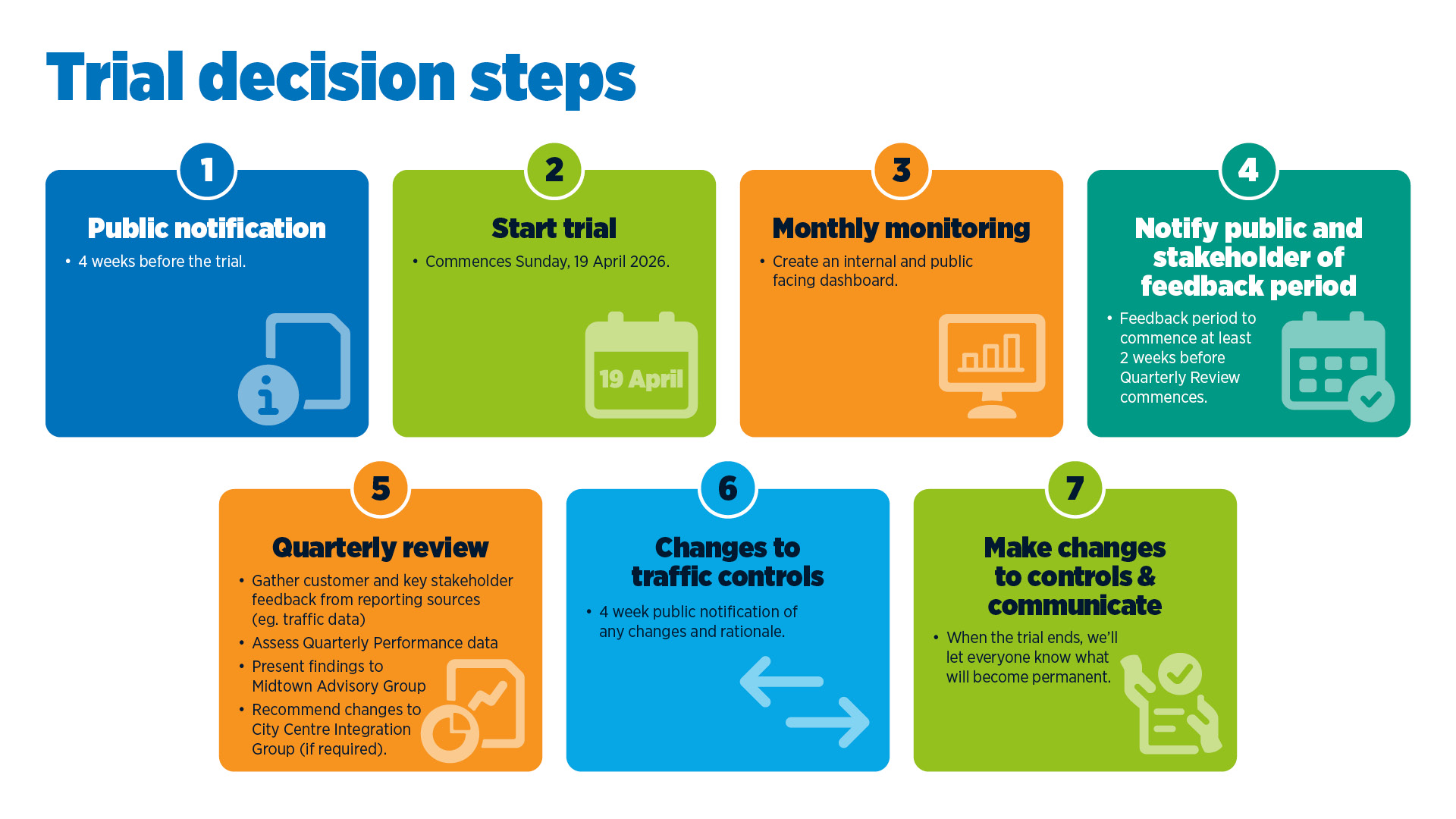
    From 19 April 2026, the trial will start under NZTA Waka Kotahi’s Reshaping Streets / Land Transport Rule: Streets Layout 2023. The trial allows for community feedback, monitoring and adjustment in real time before any permanent changes are confirmed. 

    During the trial, we’ll monitor bus reliability and travel times, pedestrian activity and safety, traffic volumes and circulation, loading/servicing access, and provide ongoing opportunities for community feedback. If issues arise, we’ll adjust settings and share updates. 

    All community feedback gathered before and during the trial will be considered and help inform changes.  A range of opportunities to listen to communities will be promoted at regular intervals throughout the trial. 

    More detailed information will be shared mid-March, one month prior to the start date. 

  • Share How will letting cars in the AVO area make Queen Street safer and more accessible? on Facebook Share How will letting cars in the AVO area make Queen Street safer and more accessible? on Twitter Share How will letting cars in the AVO area make Queen Street safer and more accessible? on Linkedin Email How will letting cars in the AVO area make Queen Street safer and more accessible? link

    How will letting cars in the AVO area make Queen Street safer and more accessible?

    Kirsty asked 11 days ago

    Fewer buses on Queen Street

    Albert Street and Mayoral Drive reopened on 29 November 2025 after eight years, bringing back nearly 900 buses daily to the newly opened corridor. This shifted 447 buses each way daily from Queen Street, where they ran during construction. 

    Mobility Parking and Access

    To support accessibility in midtown, a new mobility parking space will be created on Queen Street, just north of Wellesley Street. We are also working on a plan to whitelist Total Mobility service vehicles to travel through the Authorised Vehicles Only area (AVO).    
    Servicing, pick-up and drop-off

    The timing of the existing Loading Zone (LZ) spaces on both sides of Queen Street, just north of Wellesley Street, will be adjusted. These changes in time will align with the majority of LZ times in the city centre, at 5 minutes (Monday to Friday, 6am to 6pm), to increase turnover and improve availability for service vehicles during busy periods.  

    After 6pm on weekdays and throughout weekends, loading and pick-up/drop-off activities become a higher priority, in particular for those with access needs. To accommodate this, the vehicle loading time will be extended to 15 minutes. 

    To further support safe access to midtown, changes are underway in the Wakefield Quadrant, north of the AVO area, following consultation on Room to Move in the City Centre in 2025. These changes respond to feedback, in particular, from those with access needs visiting key cultural and entertainment destinations in the Aotea Arts Quarter. 

    • A segment of paid parking is being converted to short-term time-restricted parking (daytime with evening free for pick-up and drop-off)
    • Existing bus parking is being converted to dual use parking and loading zones (bus parking Monday to Friday 3-7pm and LZ P5 at all other times to enable servicing, pick-up and drop-off. 

    • The P15 Goods Vehicle only zone outside the Town Hall will convert to P5 LZ after 6pm to enable pick-up/drop-off. 

    • A new rideshare waiting area is proposed for Wakefield Street in the current bus parking zone. Further engagement on this change will take place during the trial period. 

    These changes respond to feedback to provide improved access to key destinations such as the Town Hall, Aotea Centre and Civic Theatre. At the same time, reducing general traffic entering the Authorised Vehicles Only (AVO) area.

  • Share Will this allow fewer buses, and therefore fewer people travelling to/from the city centre, than having 24/7 AVO and bus lanes would? on Facebook Share Will this allow fewer buses, and therefore fewer people travelling to/from the city centre, than having 24/7 AVO and bus lanes would? on Twitter Share Will this allow fewer buses, and therefore fewer people travelling to/from the city centre, than having 24/7 AVO and bus lanes would? on Linkedin Email Will this allow fewer buses, and therefore fewer people travelling to/from the city centre, than having 24/7 AVO and bus lanes would? link

    Will this allow fewer buses, and therefore fewer people travelling to/from the city centre, than having 24/7 AVO and bus lanes would?

    Dominicjacquem asked 11 days ago

    The City Centre Bus Plan will make bus journeys more efficient and reliable, and the city centre better connected for all Aucklanders no matter how they choose to travel.     

    Buses remain essential to city centre access, even after the City Rail Link opens, most public transport users will still arrive by bus.   

    Albert Street and Mayoral Drive reopened on 29 November 2025 after eight years, bringing back nearly 900 buses daily, delivering on the City Centre Bus Plan, City Centre Master Plan, and Access for Everyone. This shifted 447 buses each way from Queen Street, where they were diverted during CRL construction.

    As streets are upgraded and re-opened and the city evolves, how we move around will continue to change. The council group are shifting focus towards optimising our integrated city centre transport network post-construction.   

    We are taking a pragmatic and balanced approach to reducing obstacles for visitors, businesses and residents, supporting key destinations, and the night-time economy, while actively monitoring changes in real-time and remaining open to adapt as needed. 

    We’ll monitor bus reliability and travel times, pedestrian activity and safety, traffic volumes and circulation, loading/servicing access, and community feedback. If issues arise, we’ll adjust settings and share updates during the trial. 

Page last updated: 09 Feb 2026, 02:55 PM