Alfred Street and Church Street - Intersection Upgrade

Share Alfred Street and Church Street - Intersection Upgrade on Facebook Share Alfred Street and Church Street - Intersection Upgrade on X (formerly Twitter) Share Alfred Street and Church Street - Intersection Upgrade on Linkedin Email Alfred Street and Church Street - Intersection Upgrade link

Church Street and Alfred Street – Intersection Improvement

Engagement Summary


Thank you for helping us make better decisions for your neighbourhood, informed by your local knowledge.


Community feedback showed support for the safety intent of the project, while some respondents also raised suggestions or concerns. These matters have been reviewed and are addressed below.


Project outcome


After carefully reviewing the feedback we received, the current Auckland Council recommendation is to proceed with the project as proposed. The project will then progress through the required approval process before construction can begin.


If approvals progress as expected, we anticipate these changes will be implemented by mid-2027.


What we did


Engagement was held from 14 August 2026 to 4 September 2026.


  • 1,217 letters delivered to mailboxes on 14 August 2026
  • 1,242 postcards delivered to businesses and properties in the proposal area on 31 August 2026
  • Auckland Council social media
  • Auckland Council project webpage
  • Emails to stakeholders including emergency services, freight operators, NZ Police and schools
  • Maungakiekie-Tāmaki Local Board received an email update on 17 August 2026


We received 24 pieces of feedback.


Community Feedback


People told us:


The proposed roundabout is supported by residents. The current intersection is considered unsafe by many members of the community, particularly for right-turning vehicles exiting Alfred Street onto Church Street. The safety improvement is needed for all road users.


Feedback themes and Auckland Council response – Local Community

Support the proposal

66.7% of respondents supported the proposed safety improvements, either without qualification or with suggestions. A further 8.3% provided suggestions without expressing support or opposition.

Response:

Thank you for your feedback.

Pedestrian crossings and pedestrian and cyclist safety

Some respondents commented on pedestrian or cyclist safety and the proposed crossing arrangements. Some respondents were concerned that the crossings were too close to the roundabout or concentrated in a small area and could require vehicles to stop suddenly while entering or travelling through the intersection. Respondents felt the proposal did not go far enough and suggested additional crossings, median refuge facilities or clearer provision for people cycling.

Response:

Formal pedestrian crossings and median islands were considered during the design phase. However, due to site constraints, including a retaining wall, a steep berm and power poles, providing these pedestrian facilities would require significant physical works and is therefore not feasible.

The proposed roundabout is expected to simplify turning movements at the intersection, reduce approach speeds and improve overall safety for all road users, including pedestrians and cyclists.

We know that pedestrians generally take the most direct route when crossing, so it is important to locate pedestrian crossings on desire lines to encourage people to use the facility.

Traffic flow, roundabout operation and alternative treatments

Some respondents commented on traffic flow, roundabout operation or alternative treatments. Comments expected easier turning movements or improved traffic flow. Some respondents preferred traffic signals to the proposed roundabout. Respondents raised concerns about possible delays, congestion or traffic diversion to nearby streets, and access or manoeuvring concerns for trucks, buses, emergency vehicles or other large vehicles.

Response:

Traffic signals – Traffic signals were considered during the investigation stage. Traffic modelling was carried out for both the traffic signal and roundabout options. The assessment showed that traffic signals would cause more delays to traffic flow than a roundabout.

Heavy vehicle movements (trucks, buses, emergency vehicles and other large vehicles) – The roundabout has been designed with a mountable central island to accommodate heavy vehicle movements through the intersection.

Parking and no-stopping changes

Some respondents raised concerns about the removal of roadside parking and the extent of the proposed no-stopping areas. Feedback included concerns about displaced parking, reduced available parking and the number of spaces affected by the proposal.

Response:

We recognise that on-street parking is a valuable resource and have minimised the loss of parking as much as possible. The parking removal is required to provide adequate visibility so that road users can safely navigate the new roundabout. Our parking surveys show that demand for parking directly at the intersection is relatively low.

Speed cushions

Some respondents suggested changes to the proposed speed cushions. Respondent considered them unnecessary because the roundabout and road layout should already slow vehicles. Comment also suggested limiting speed cushions to intersection entries, or keeping any exit treatment shallow, to reduce noise and vehicle wear.

Response:

We confirm that the speed cushions are limited to the approaches to the intersection and will help ensure that vehicles travel at an appropriate speed through the intersection. Due to site constraints, installing traffic islands on the approaches to slow vehicles would require significant physical works and is therefore not feasible. The speed cushions are designed to minimise impacts on heavy vehicles, such as buses.

Construction and delivery

Some respondents commented on construction impacts. Respondents asked that midnight or night works be avoided because of noise. Other respondents preferred night works to reduce daytime traffic congestion.

Response:

We will take this into consideration when developing the construction methodology and traffic management plan. We will work closely with the contractor to minimise impacts on the community during construction.

Stormwater, drainage and related maintenance

Some respondents asked for existing stormwater or drainage issues around the intersection to be addressed alongside the works. Feedback referred to water rising from drains, blocked drainage and the risk of water pooling near speed cushions. Comment also raised existing kerb damage caused by large vehicles and asked that similar damage be prevented at the new layout.

Response:

We will ensure that the proposal does not create stormwater issues at the intersection. Where feasible, we will replace damaged kerbing at the intersection. The design will enable heavy vehicles to manoeuvre safely through the intersection.

Project necessity and value

Some respondents questioned whether the crash history justified the scale and cost of the proposal and considered several proposed elements unnecessary.

Response:

The intersection has a poor safety record, with 15 crashes reported between 2021 and 2025. In the past, we have also received several requests from the community for safety improvements at the intersection.

Other requested improvements and locations

Some respondents requested additional or different improvements beyond the main proposal. Feedback included wider and clearer roads, further investment in the surrounding area, additional safety measures along Alfred Street to address heavy traffic and speeding, and broader traffic calming across Onehunga.

Response:

Unfortunately, due to budget and programme constraints, we are unable to extend the project area beyond the intersection.


Feedback themes and Auckland Council response – Key Stakeholder

NZHHA / heavy haulage

The Heavy Haulage Association was contacted as a stakeholder given the intersection's potential impact on heavy vehicle movements. They submitted a report which outlined their support for the project.

Response: We responded that we acknowledge their submission and will let them know of the project outcome.


We are working to make it easier and safer for you to access the intersection of Church Street and Alfred Street in Onehunga.


What we are doing

We are working to make it easier and safer for you to access the intersection of Church Street and Alfred Street in Onehunga. The proposed roundabout will help slow vehicles and make it clearer and safer for people to move through the intersection, whether you are walking, cycling, driving, living nearby, working or visiting the area.

What we are proposing

We are proposing the following safety upgrades at the Church Street and Alfred Street intersection:

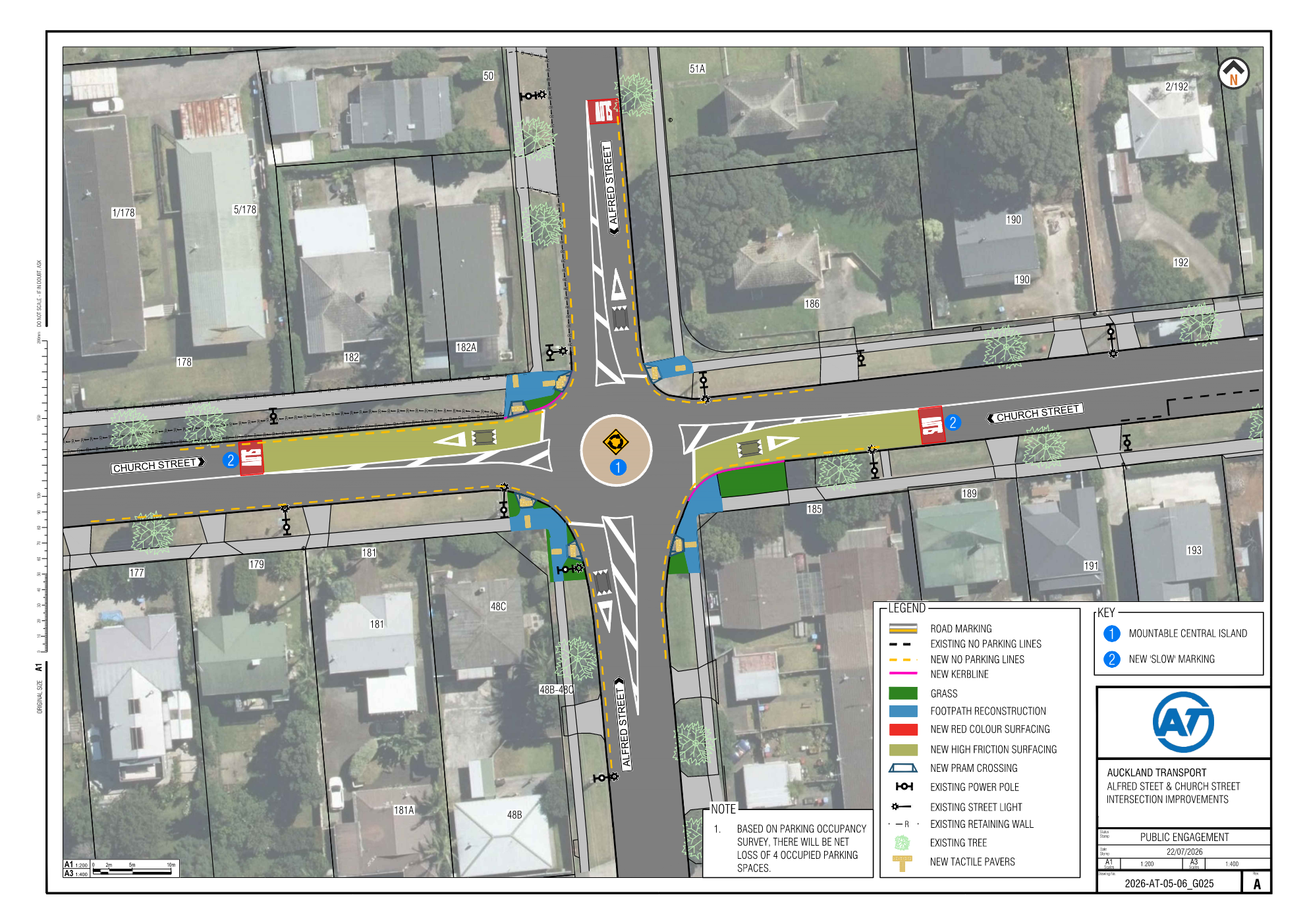
  • Install a new fully mountable roundabout with high friction surfacing and rubber speed cushions on all approaches to help slow traffic and support safer crossing and turning movements from Alfred Street.
  • Provide three new pram crossings: one pedestrian pram crossing on Church Street west, one pedestrian pram crossing on Alfred Street north and one pedestrian pram crossing on Alfred Street south.
  • Widen footpaths, realign kerbs and berms, and update road markings and signs to support the new layout.
  • Improve street lighting so the crossings and roundabout are easier to see, especially at night.
  • Install new broken yellow lines (No Stopping At All Times) to support the roundabout layout.

To improve safety and visibility at the intersection, broken yellow lines will be installed to clearly identify where vehicles must not stop or park.

Under the Land Transport (Road User) Rule 2004, vehicles must not stop, stand or park within an intersection or within 6 metres of an intersection, unless parking is specifically authorised by signs or markings. This restriction applies even where broken yellow lines are not currently present; the new markings will make the restriction clearer and support parking compliance.

Overall, the changes will affect kerbside space equivalent to approximately 24 vehicles. However, our parking survey found that only 4 of these spaces are regularly used. The remaining areas are either not regularly used or include locations where parking is already prohibited due to their proximity to the intersection. You can find the parking survey results in the map below.
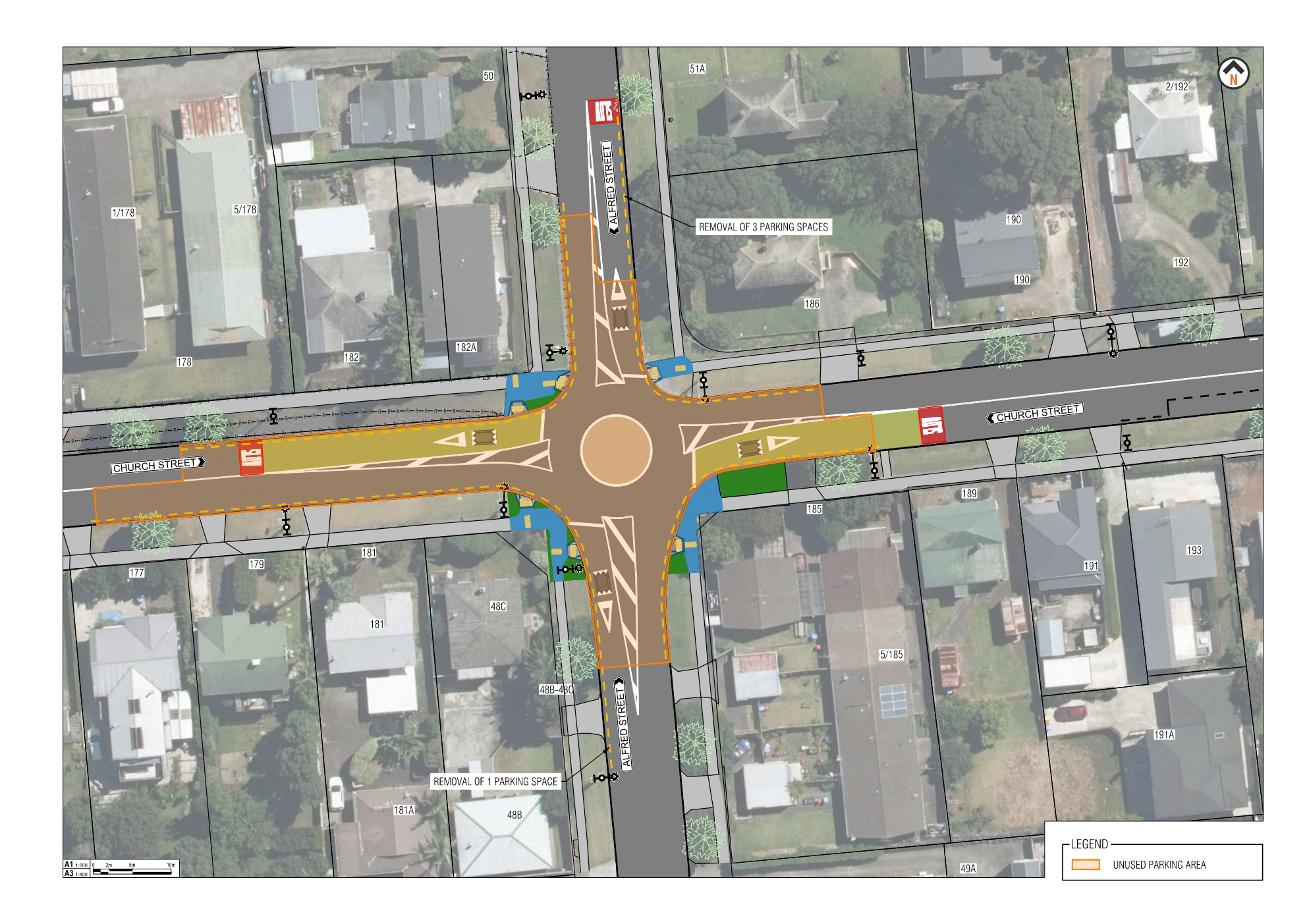
Therefore, the practical impact is expected to be the removal of approximately 4 regularly used roadside parking spaces. Parking will continue to be available outside the marked no-stopping areas.

This includes the following changes:

On Alfred Street:

  • Remove 3 parking spaces outside 51A Alfred Street and 186 Church Street on Alfred Street north approach.
  • Remove 1 parking space outside 48B Alfred Street on Alfred Street south approach.

You can view the proposed layout in the attached plans.
How this will benefit your neighbourhood

These improvements will help make the intersection safer and more predictable for everyone using the area. Key benefits include:

  • Better traffic flow and reduce delays on Alfred Street.
  • Safer and easier turning manoeuvres at the intersection.
  • A clearer, more visible road layout.
  • Improved visibility and lower speed environment, enhance safety for all road users.

Why we doing this

Improving safety

  • Fifteen crashes were reported between 2021 and 2025, including one serious-injury crash and nine minor-injury crashes.

Making the intersection safer for everyone

  • Our investigation identified 80% of these crashes involved vehicles crossing or turning, highlighting the existing crossing and turning risks.
  • Two crashes involved vulnerable road users (one cyclist and one motorcyclist).
  • The proposed improvements will reduce crash risk and make the area safer, more accessible and better connected.

Church Street and Alfred Street – Intersection Improvement

Engagement Summary


Thank you for helping us make better decisions for your neighbourhood, informed by your local knowledge.


Community feedback showed support for the safety intent of the project, while some respondents also raised suggestions or concerns. These matters have been reviewed and are addressed below.


Project outcome


After carefully reviewing the feedback we received, the current Auckland Council recommendation is to proceed with the project as proposed. The project will then progress through the required approval process before construction can begin.


If approvals progress as expected, we anticipate these changes will be implemented by mid-2027.


What we did


Engagement was held from 14 August 2026 to 4 September 2026.


  • 1,217 letters delivered to mailboxes on 14 August 2026
  • 1,242 postcards delivered to businesses and properties in the proposal area on 31 August 2026
  • Auckland Council social media
  • Auckland Council project webpage
  • Emails to stakeholders including emergency services, freight operators, NZ Police and schools
  • Maungakiekie-Tāmaki Local Board received an email update on 17 August 2026


We received 24 pieces of feedback.


Community Feedback


People told us:


The proposed roundabout is supported by residents. The current intersection is considered unsafe by many members of the community, particularly for right-turning vehicles exiting Alfred Street onto Church Street. The safety improvement is needed for all road users.


Feedback themes and Auckland Council response – Local Community

Support the proposal

66.7% of respondents supported the proposed safety improvements, either without qualification or with suggestions. A further 8.3% provided suggestions without expressing support or opposition.

Response:

Thank you for your feedback.

Pedestrian crossings and pedestrian and cyclist safety

Some respondents commented on pedestrian or cyclist safety and the proposed crossing arrangements. Some respondents were concerned that the crossings were too close to the roundabout or concentrated in a small area and could require vehicles to stop suddenly while entering or travelling through the intersection. Respondents felt the proposal did not go far enough and suggested additional crossings, median refuge facilities or clearer provision for people cycling.

Response:

Formal pedestrian crossings and median islands were considered during the design phase. However, due to site constraints, including a retaining wall, a steep berm and power poles, providing these pedestrian facilities would require significant physical works and is therefore not feasible.

The proposed roundabout is expected to simplify turning movements at the intersection, reduce approach speeds and improve overall safety for all road users, including pedestrians and cyclists.

We know that pedestrians generally take the most direct route when crossing, so it is important to locate pedestrian crossings on desire lines to encourage people to use the facility.

Traffic flow, roundabout operation and alternative treatments

Some respondents commented on traffic flow, roundabout operation or alternative treatments. Comments expected easier turning movements or improved traffic flow. Some respondents preferred traffic signals to the proposed roundabout. Respondents raised concerns about possible delays, congestion or traffic diversion to nearby streets, and access or manoeuvring concerns for trucks, buses, emergency vehicles or other large vehicles.

Response:

Traffic signals – Traffic signals were considered during the investigation stage. Traffic modelling was carried out for both the traffic signal and roundabout options. The assessment showed that traffic signals would cause more delays to traffic flow than a roundabout.

Heavy vehicle movements (trucks, buses, emergency vehicles and other large vehicles) – The roundabout has been designed with a mountable central island to accommodate heavy vehicle movements through the intersection.

Parking and no-stopping changes

Some respondents raised concerns about the removal of roadside parking and the extent of the proposed no-stopping areas. Feedback included concerns about displaced parking, reduced available parking and the number of spaces affected by the proposal.

Response:

We recognise that on-street parking is a valuable resource and have minimised the loss of parking as much as possible. The parking removal is required to provide adequate visibility so that road users can safely navigate the new roundabout. Our parking surveys show that demand for parking directly at the intersection is relatively low.

Speed cushions

Some respondents suggested changes to the proposed speed cushions. Respondent considered them unnecessary because the roundabout and road layout should already slow vehicles. Comment also suggested limiting speed cushions to intersection entries, or keeping any exit treatment shallow, to reduce noise and vehicle wear.

Response:

We confirm that the speed cushions are limited to the approaches to the intersection and will help ensure that vehicles travel at an appropriate speed through the intersection. Due to site constraints, installing traffic islands on the approaches to slow vehicles would require significant physical works and is therefore not feasible. The speed cushions are designed to minimise impacts on heavy vehicles, such as buses.

Construction and delivery

Some respondents commented on construction impacts. Respondents asked that midnight or night works be avoided because of noise. Other respondents preferred night works to reduce daytime traffic congestion.

Response:

We will take this into consideration when developing the construction methodology and traffic management plan. We will work closely with the contractor to minimise impacts on the community during construction.

Stormwater, drainage and related maintenance

Some respondents asked for existing stormwater or drainage issues around the intersection to be addressed alongside the works. Feedback referred to water rising from drains, blocked drainage and the risk of water pooling near speed cushions. Comment also raised existing kerb damage caused by large vehicles and asked that similar damage be prevented at the new layout.

Response:

We will ensure that the proposal does not create stormwater issues at the intersection. Where feasible, we will replace damaged kerbing at the intersection. The design will enable heavy vehicles to manoeuvre safely through the intersection.

Project necessity and value

Some respondents questioned whether the crash history justified the scale and cost of the proposal and considered several proposed elements unnecessary.

Response:

The intersection has a poor safety record, with 15 crashes reported between 2021 and 2025. In the past, we have also received several requests from the community for safety improvements at the intersection.

Other requested improvements and locations

Some respondents requested additional or different improvements beyond the main proposal. Feedback included wider and clearer roads, further investment in the surrounding area, additional safety measures along Alfred Street to address heavy traffic and speeding, and broader traffic calming across Onehunga.

Response:

Unfortunately, due to budget and programme constraints, we are unable to extend the project area beyond the intersection.


Feedback themes and Auckland Council response – Key Stakeholder

NZHHA / heavy haulage

The Heavy Haulage Association was contacted as a stakeholder given the intersection's potential impact on heavy vehicle movements. They submitted a report which outlined their support for the project.

Response: We responded that we acknowledge their submission and will let them know of the project outcome.


We are working to make it easier and safer for you to access the intersection of Church Street and Alfred Street in Onehunga.


What we are doing

We are working to make it easier and safer for you to access the intersection of Church Street and Alfred Street in Onehunga. The proposed roundabout will help slow vehicles and make it clearer and safer for people to move through the intersection, whether you are walking, cycling, driving, living nearby, working or visiting the area.

What we are proposing

We are proposing the following safety upgrades at the Church Street and Alfred Street intersection:

  • Install a new fully mountable roundabout with high friction surfacing and rubber speed cushions on all approaches to help slow traffic and support safer crossing and turning movements from Alfred Street.
  • Provide three new pram crossings: one pedestrian pram crossing on Church Street west, one pedestrian pram crossing on Alfred Street north and one pedestrian pram crossing on Alfred Street south.
  • Widen footpaths, realign kerbs and berms, and update road markings and signs to support the new layout.
  • Improve street lighting so the crossings and roundabout are easier to see, especially at night.
  • Install new broken yellow lines (No Stopping At All Times) to support the roundabout layout.

To improve safety and visibility at the intersection, broken yellow lines will be installed to clearly identify where vehicles must not stop or park.

Under the Land Transport (Road User) Rule 2004, vehicles must not stop, stand or park within an intersection or within 6 metres of an intersection, unless parking is specifically authorised by signs or markings. This restriction applies even where broken yellow lines are not currently present; the new markings will make the restriction clearer and support parking compliance.

Overall, the changes will affect kerbside space equivalent to approximately 24 vehicles. However, our parking survey found that only 4 of these spaces are regularly used. The remaining areas are either not regularly used or include locations where parking is already prohibited due to their proximity to the intersection. You can find the parking survey results in the map below.

Therefore, the practical impact is expected to be the removal of approximately 4 regularly used roadside parking spaces. Parking will continue to be available outside the marked no-stopping areas.

This includes the following changes:

On Alfred Street:

  • Remove 3 parking spaces outside 51A Alfred Street and 186 Church Street on Alfred Street north approach.
  • Remove 1 parking space outside 48B Alfred Street on Alfred Street south approach.

You can view the proposed layout in the attached plans.

How this will benefit your neighbourhood

These improvements will help make the intersection safer and more predictable for everyone using the area. Key benefits include:

  • Better traffic flow and reduce delays on Alfred Street.
  • Safer and easier turning manoeuvres at the intersection.
  • A clearer, more visible road layout.
  • Improved visibility and lower speed environment, enhance safety for all road users.

Why we doing this

Improving safety

  • Fifteen crashes were reported between 2021 and 2025, including one serious-injury crash and nine minor-injury crashes.

Making the intersection safer for everyone

  • Our investigation identified 80% of these crashes involved vehicles crossing or turning, highlighting the existing crossing and turning risks.
  • Two crashes involved vulnerable road users (one cyclist and one motorcyclist).
  • The proposed improvements will reduce crash risk and make the area safer, more accessible and better connected.
  • CLOSED: This survey has concluded.
    Share Alfred Street and Church Street – Intersection Improvement on Facebook Share Alfred Street and Church Street – Intersection Improvement on X (formerly Twitter) Share Alfred Street and Church Street – Intersection Improvement on Linkedin Email Alfred Street and Church Street – Intersection Improvement link
Page last updated: 27 Oct 2026, 04:59 PM