Favona Road and Harania Avenue – Intersection Improvements

Share Favona Road and Harania Avenue – Intersection Improvements on Facebook Share Favona Road and Harania Avenue – Intersection Improvements on X (formerly Twitter) Share Favona Road and Harania Avenue – Intersection Improvements on Linkedin Email Favona Road and Harania Avenue – Intersection Improvements link

Favona Road and Harania Avenue – Intersection Improvement


Engagement Summary


Thank you for helping us make better decisions for your neighbourhood, informed by your local knowledge.


Community feedback showed support for the safety intent of the project, while some respondents also raised suggestions or concerns. These matters have been reviewed and are addressed below.


Project outcome


After carefully reviewing the feedback we received, we are proceeding with the project as proposed.


We expect to have these changes implemented by mid-2027.


What we did


Engagement was held from 22 June 2026 to 24 July 2026


  • 1,309 letters delivered to mailboxes on 26 June 2026
  • 2,820 postcards delivered to businesses and properties in the proposal area on 6 July 2026
  • AT social media
  • AT project webpage: https://haveyoursay.at.govt.nz/favona-harania
  • Emails to stakeholders including emergency services, freight operators, NZ Police and schools
  • Māngere-Ōtāhuhu Local Board received an email update on 17 June 2026


We received 36 pieces of feedback.


Community Feedback


People told us:


  • The proposed signalised intersection and pedestrian crossings are supported by residents. The current intersection is considered unsafe by many members of the community, particularly for right-turning vehicles exiting Harania Avenue onto Favona Road. These safety improvements are needed for pedestrians, especially elderly residents, or those with disabilities.


Feedback themes and AT responses

Support the Proposal


86.1% of respondents supported the proposed signalised intersection as a necessary improvement to control the traffic flow, provide safe crossing points for vulnerable users and reduce crash risk.


Response:

Thank you for your feedback.

Traffic Flow, Congestion and Signal Operation


Some respondents expressed concern that the proposal could increase congestion, delays, queue lengths, and disruptions to traffic flow. Comments focused on signal detection, timing, and phasing, with suggestions that the signals should better respond to varying traffic demands during peak, off-peak, and night-time periods. Some respondents also questioned whether a single exit lane from Harania Avenue would provide sufficient capacity to accommodate traffic volumes.


Response: Auckland Transport acknowledges the concerns raised about traffic flow, congestion, queueing and signal operation. As part of the design and investigation work for this project, traffic surveys were undertaken and used to model different intersection layout options. This modelling helped assess expected delays, the capacity needed for each approach, and how different turning movements would operate. Based on this work, the proposed traffic signal layout presented during consultation is considered the best option to balance traffic flow, improve safety, and make efficient use of the available road space. If the project proceeds, the signal timings would also be reviewed and adjusted as needed once the signals are operating, to help manage traffic during peak and off-peak periods.

Road Layout and Turning Movements


Several respondents suggested additional road capacity measures, including extra lanes, a dedicated left-turn lane, or a left-turn slip lane. Some proposed replacing the intersection with a roundabout. Other suggestions included installing a raised median or improving turning facilities. Some respondents recommended restricting right turns from Favona Road into Harania Avenue, while others suggested allowing right turns into Harania Avenue during off-peak periods. Some respondents also requested stronger enforcement of the existing right-turn restriction at the Mainfreight driveway.


Response: Auckland Transport acknowledges the suggestions received about changing the road layout, adding lanes or restricting some turning movements. As part of the investigation, traffic surveys were carried out to understand the demand for each movement at the intersection. This information was used with traffic modelling software to test the signal layout. Based on this assessment, the proposed layout is considered the most appropriate option for managing traffic movements safely and efficiently within the available road space. Restricting certain movements is not expected to provide additional safety benefits and could create wider congestion impacts by shifting traffic to other routes or movements. The ability to add further lanes is also limited by the existing road widths and surrounding property constraints, so the design has focused on making the best use of the space available.

Construction and Delivery Concerns


Some respondents raised concerns about construction-related traffic impacts, including traffic management measures and potential detours. Some expressed concern about noise from night-time construction activities. There was also a desire for the project to be delivered promptly, with requests for information on construction timing and for advance communication of construction activities through community channels such as local community pages and letter drops.


Response: Auckland Transport acknowledges the concerns raised about construction impacts, including traffic management, detours, noise and the timing of work. If the project proceeds, affected residents, businesses and road users would be informed before construction starts, and traffic management plans would be prepared to help manage vehicle and pedestrian movements while the work is carried out. As the project is still at the consultation stage, the detailed construction methodology, timing and traffic management arrangements have not yet been confirmed. These details would be developed at a later stage, subject to the outcome of consultation and Local Board review.

Pedestrian Crossings and Footpath Safety


Some respondents expected the proposal to improve pedestrian safety and make crossing the road easier. However, some concerns were raised about the proposed crossing design, including opposition to a raised crossing and the view that the existing crossing is adequate given the perceived low level of pedestrian activity. Other comments highlighted safety issues associated with vehicles parking on a footpath used by schoolchildren and requested improvements to the crossing near the local shops.


Response: The proposed traffic signals will upgrade the crossing facilities on all legs of the intersection by providing signal-controlled pedestrian crossings. This will give pedestrians a clearer and safer way to cross, improve accessibility for people walking through the area, and better support to vulnerable users such as schoolchildren, older people and people with disabilities.

Project Necessity and Alternatives


Some respondents questioned whether traffic signals were necessary or the most effective solution for addressing the issues at the intersection. Some requested a clearer explanation of the problem being addressed, including more information on the causes and nature of the reported crashes. Concerns were also raised about the level of pedestrian activity and turning demand at the location. Some respondents considered that the primary safety issue was right turns from Favona Road into Harania Avenue and suggested restricting this movement as a more targeted intervention.


Response: Auckland Transport acknowledges the feedback asking whether traffic signals are necessary and whether other options were considered. The Favona Road and Harania Avenue intersection has been identified as a high-risk location due to its crash history and the existing challenges for vehicles, pedestrians and other road users moving through the intersection. As part of the investigation, AT considered different improvement options, including traffic signals and a roundabout. Traffic signals are the preferred option because they can provide controlled movements for all road users, improve pedestrian crossing safety, and manage turning movements while minimising the impact on traffic using Favona Road, particularly during peak periods. This option is considered the most appropriate way to address the current safety issues while supporting the ongoing operation of Favona Road as a busy transport and freight route.

Parking & Access


Some respondents raised concerns about heavy vehicle volumes, truck queueing, and access to industrial properties. Parking-related issues were also frequently mentioned, including parking near the intersection, on footpaths, outside industrial sites, and the potential removal of parking near the mosque. Comments highlighted the need to keep parking and access areas clear to support traffic flow and property access. Additional concerns included parked vehicles restricting the space available for buses turning into Harania Avenue and a request for a hatched clearway area outside 80 Favona Road to improve heavy vehicle access.


Response: Auckland Transport acknowledges the concerns raised about heavy-vehicle movements, parking and access near the intersection. Favona Road is a designated freight route, so heavy-vehicle activity is expected to remain a key part of how this corridor operates. The proposed changes have been designed with this in mind, including checks of vehicle tracking and visibility to support safe access and turning movements. Parking has been retained where it can be safely accommodated and removed only in locations where it could create access, visibility or safety issues. AT will provide limit lines and “keep clear” road markings outside the 80 Favona Road high-use driveway, to help remind road users to leave space for vehicles entering and exiting the property.

Driver Behaviour


Some respondents raised concerns about speeding and impatient or unsafe driving behaviour. Suggestions for improving compliance and safety included the installation of a red-light camera, the use of signage encouraging drivers to reduce their speed, and stronger enforcement of the existing right-turn restriction at the Mainfreight driveway. However, concerns were also expressed about the use of enforcement cameras, particularly in relation to privacy.


Response: Auckland Transport acknowledges the concerns raised about unsafe driver behaviour at this intersection, including speeding, impatience and possible red-light running. The proposed traffic signals are expected to improve safety by clearly controlling vehicle and pedestrian movements through the intersection and reducing the need for drivers to find gaps in traffic. Red-light cameras are generally considered where there is evidence of drivers not complying with existing traffic signals. As these would be new signals, AT would monitor how they operate once installed and consider further measures, such as enforcement support, if ongoing safety or compliance issues are identified. The signal design has also taken into account the nearby high-use industrial driveways to help maintain access and support safe operation for vehicles entering and exiting these properties.


NZHHA / heavy haulage


The Heavy Haulage Association was contacted as a stakeholder given the intersection's potential impact on heavy vehicle movements. They submitted a report which outlined their support for the project.


Response:

We responded that we acknowledge their submission and will let them know of the project outcome.


What happens next


After carefully reviewing the feedback we received, we are proceeding with the project as proposed.


We expect to have these changes implemented by mid-2027.


We'll be in touch with residents in the affected work areas before construction begins.


About the project

Safety improvements at Favona Road and Harania Avenue Intersection

We are working to make it easier and safer for you to access the intersection of Favona Road and Harania Avenue. These upgrades are designed to improve safety for everyone using Favona Rd and Harania Ave intersection, whether you live, work, or visit the area.

Currently, access to this intersection is a high risk, which has been a safety concern for the community. It is currently ranked as the 27th highest risk intersection on the Auckland roading network. In the past, there were 15 reported crashes, 7 resulting in minor injuries. The current road layout isn’t easy for people to move around, which means accidents are more likely. By making these improvements, we’ll create a safer, more accessible, and better-connected space for everyone who lives, works, or visits this area.


What we’re planning to do before June 2027

We are proposing the following safety upgrades at the Favona Road and Harania Avenue intersection:

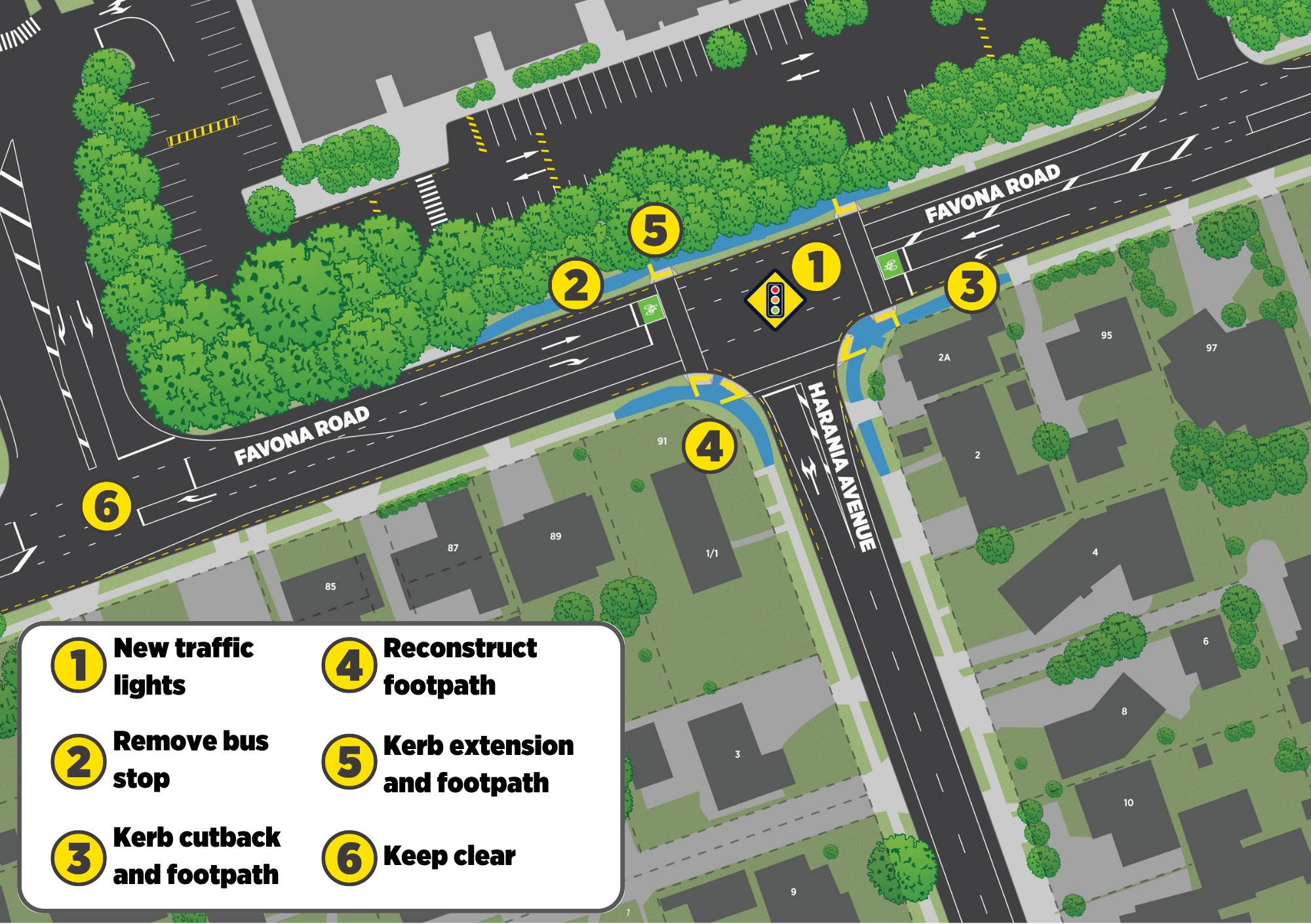
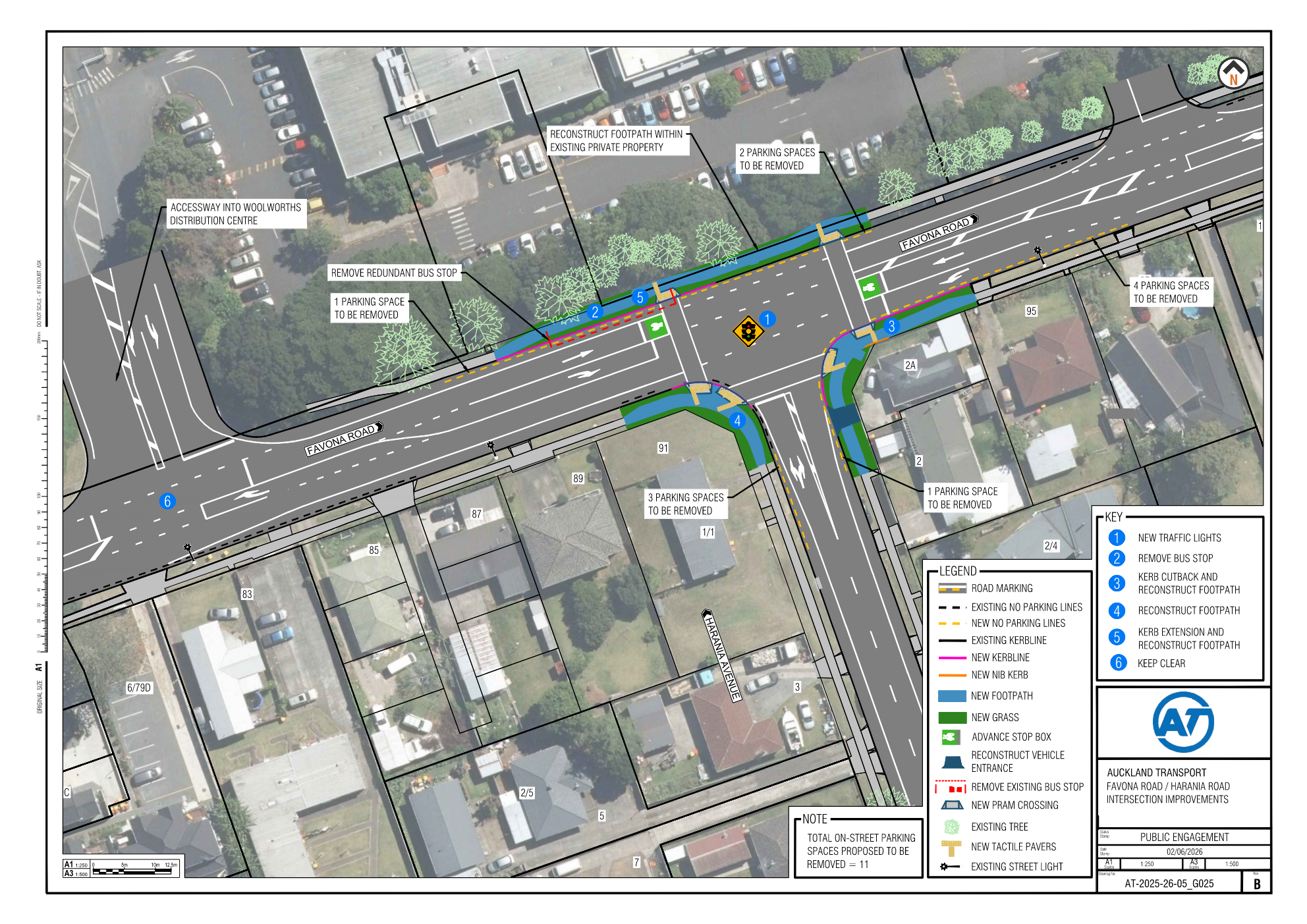
  • Install traffic lights including new signalised pedestrian crossings at the intersection and an additional left turning lane from Favona Road into Harania Avenue.
  • Reconstruct the footpath, kerb line and grass berm where necessary.
  • Reconstruct the driveway outside 2A Harania Avenue.
  • Improve the road surface, signs, and road markings where needed.
  • Remove the redundant bus stop and realign the kerb and footpath.
  • As a result, 11 parking spaces from the surrounding area will be removed.

This includes the following changes:

    • Remove 3 parking spaces outside 80 Favona Road.
    • Remove 4 parking spaces outside 95 Favona Road.
    • Remove 3 parking spaces outside 1 Harania Avenue.
    • Remove 1 parking space outside 2 Harania Avenue.

You can view the proposed layout in the attached plans.
How this will benefit your neighbourhood

These improvements will help make the intersection safer and more predictable for everyone using the area. Key benefits include:

  • Safer and smoother turning manoeuvres from Harania Avenue to Favona Road.
  • Safer crossing points for people walking.
  • A clearer, more visible road layout.


What happens next

Thank you of your support.

The survey has now been closed, and we are reviewing the feedback.

We'll post the outcome of this proposal and a summary of community feedback on our website.

Any change to the plan will be updated on our website.

Favona Road and Harania Avenue – Intersection Improvement


Engagement Summary


Thank you for helping us make better decisions for your neighbourhood, informed by your local knowledge.


Community feedback showed support for the safety intent of the project, while some respondents also raised suggestions or concerns. These matters have been reviewed and are addressed below.


Project outcome


After carefully reviewing the feedback we received, we are proceeding with the project as proposed.


We expect to have these changes implemented by mid-2027.


What we did


Engagement was held from 22 June 2026 to 24 July 2026


  • 1,309 letters delivered to mailboxes on 26 June 2026
  • 2,820 postcards delivered to businesses and properties in the proposal area on 6 July 2026
  • AT social media
  • AT project webpage: https://haveyoursay.at.govt.nz/favona-harania
  • Emails to stakeholders including emergency services, freight operators, NZ Police and schools
  • Māngere-Ōtāhuhu Local Board received an email update on 17 June 2026


We received 36 pieces of feedback.


Community Feedback


People told us:


  • The proposed signalised intersection and pedestrian crossings are supported by residents. The current intersection is considered unsafe by many members of the community, particularly for right-turning vehicles exiting Harania Avenue onto Favona Road. These safety improvements are needed for pedestrians, especially elderly residents, or those with disabilities.


Feedback themes and AT responses

Support the Proposal


86.1% of respondents supported the proposed signalised intersection as a necessary improvement to control the traffic flow, provide safe crossing points for vulnerable users and reduce crash risk.


Response:

Thank you for your feedback.

Traffic Flow, Congestion and Signal Operation


Some respondents expressed concern that the proposal could increase congestion, delays, queue lengths, and disruptions to traffic flow. Comments focused on signal detection, timing, and phasing, with suggestions that the signals should better respond to varying traffic demands during peak, off-peak, and night-time periods. Some respondents also questioned whether a single exit lane from Harania Avenue would provide sufficient capacity to accommodate traffic volumes.


Response: Auckland Transport acknowledges the concerns raised about traffic flow, congestion, queueing and signal operation. As part of the design and investigation work for this project, traffic surveys were undertaken and used to model different intersection layout options. This modelling helped assess expected delays, the capacity needed for each approach, and how different turning movements would operate. Based on this work, the proposed traffic signal layout presented during consultation is considered the best option to balance traffic flow, improve safety, and make efficient use of the available road space. If the project proceeds, the signal timings would also be reviewed and adjusted as needed once the signals are operating, to help manage traffic during peak and off-peak periods.

Road Layout and Turning Movements


Several respondents suggested additional road capacity measures, including extra lanes, a dedicated left-turn lane, or a left-turn slip lane. Some proposed replacing the intersection with a roundabout. Other suggestions included installing a raised median or improving turning facilities. Some respondents recommended restricting right turns from Favona Road into Harania Avenue, while others suggested allowing right turns into Harania Avenue during off-peak periods. Some respondents also requested stronger enforcement of the existing right-turn restriction at the Mainfreight driveway.


Response: Auckland Transport acknowledges the suggestions received about changing the road layout, adding lanes or restricting some turning movements. As part of the investigation, traffic surveys were carried out to understand the demand for each movement at the intersection. This information was used with traffic modelling software to test the signal layout. Based on this assessment, the proposed layout is considered the most appropriate option for managing traffic movements safely and efficiently within the available road space. Restricting certain movements is not expected to provide additional safety benefits and could create wider congestion impacts by shifting traffic to other routes or movements. The ability to add further lanes is also limited by the existing road widths and surrounding property constraints, so the design has focused on making the best use of the space available.

Construction and Delivery Concerns


Some respondents raised concerns about construction-related traffic impacts, including traffic management measures and potential detours. Some expressed concern about noise from night-time construction activities. There was also a desire for the project to be delivered promptly, with requests for information on construction timing and for advance communication of construction activities through community channels such as local community pages and letter drops.


Response: Auckland Transport acknowledges the concerns raised about construction impacts, including traffic management, detours, noise and the timing of work. If the project proceeds, affected residents, businesses and road users would be informed before construction starts, and traffic management plans would be prepared to help manage vehicle and pedestrian movements while the work is carried out. As the project is still at the consultation stage, the detailed construction methodology, timing and traffic management arrangements have not yet been confirmed. These details would be developed at a later stage, subject to the outcome of consultation and Local Board review.

Pedestrian Crossings and Footpath Safety


Some respondents expected the proposal to improve pedestrian safety and make crossing the road easier. However, some concerns were raised about the proposed crossing design, including opposition to a raised crossing and the view that the existing crossing is adequate given the perceived low level of pedestrian activity. Other comments highlighted safety issues associated with vehicles parking on a footpath used by schoolchildren and requested improvements to the crossing near the local shops.


Response: The proposed traffic signals will upgrade the crossing facilities on all legs of the intersection by providing signal-controlled pedestrian crossings. This will give pedestrians a clearer and safer way to cross, improve accessibility for people walking through the area, and better support to vulnerable users such as schoolchildren, older people and people with disabilities.

Project Necessity and Alternatives


Some respondents questioned whether traffic signals were necessary or the most effective solution for addressing the issues at the intersection. Some requested a clearer explanation of the problem being addressed, including more information on the causes and nature of the reported crashes. Concerns were also raised about the level of pedestrian activity and turning demand at the location. Some respondents considered that the primary safety issue was right turns from Favona Road into Harania Avenue and suggested restricting this movement as a more targeted intervention.


Response: Auckland Transport acknowledges the feedback asking whether traffic signals are necessary and whether other options were considered. The Favona Road and Harania Avenue intersection has been identified as a high-risk location due to its crash history and the existing challenges for vehicles, pedestrians and other road users moving through the intersection. As part of the investigation, AT considered different improvement options, including traffic signals and a roundabout. Traffic signals are the preferred option because they can provide controlled movements for all road users, improve pedestrian crossing safety, and manage turning movements while minimising the impact on traffic using Favona Road, particularly during peak periods. This option is considered the most appropriate way to address the current safety issues while supporting the ongoing operation of Favona Road as a busy transport and freight route.

Parking & Access


Some respondents raised concerns about heavy vehicle volumes, truck queueing, and access to industrial properties. Parking-related issues were also frequently mentioned, including parking near the intersection, on footpaths, outside industrial sites, and the potential removal of parking near the mosque. Comments highlighted the need to keep parking and access areas clear to support traffic flow and property access. Additional concerns included parked vehicles restricting the space available for buses turning into Harania Avenue and a request for a hatched clearway area outside 80 Favona Road to improve heavy vehicle access.


Response: Auckland Transport acknowledges the concerns raised about heavy-vehicle movements, parking and access near the intersection. Favona Road is a designated freight route, so heavy-vehicle activity is expected to remain a key part of how this corridor operates. The proposed changes have been designed with this in mind, including checks of vehicle tracking and visibility to support safe access and turning movements. Parking has been retained where it can be safely accommodated and removed only in locations where it could create access, visibility or safety issues. AT will provide limit lines and “keep clear” road markings outside the 80 Favona Road high-use driveway, to help remind road users to leave space for vehicles entering and exiting the property.

Driver Behaviour


Some respondents raised concerns about speeding and impatient or unsafe driving behaviour. Suggestions for improving compliance and safety included the installation of a red-light camera, the use of signage encouraging drivers to reduce their speed, and stronger enforcement of the existing right-turn restriction at the Mainfreight driveway. However, concerns were also expressed about the use of enforcement cameras, particularly in relation to privacy.


Response: Auckland Transport acknowledges the concerns raised about unsafe driver behaviour at this intersection, including speeding, impatience and possible red-light running. The proposed traffic signals are expected to improve safety by clearly controlling vehicle and pedestrian movements through the intersection and reducing the need for drivers to find gaps in traffic. Red-light cameras are generally considered where there is evidence of drivers not complying with existing traffic signals. As these would be new signals, AT would monitor how they operate once installed and consider further measures, such as enforcement support, if ongoing safety or compliance issues are identified. The signal design has also taken into account the nearby high-use industrial driveways to help maintain access and support safe operation for vehicles entering and exiting these properties.


NZHHA / heavy haulage


The Heavy Haulage Association was contacted as a stakeholder given the intersection's potential impact on heavy vehicle movements. They submitted a report which outlined their support for the project.


Response:

We responded that we acknowledge their submission and will let them know of the project outcome.


What happens next


After carefully reviewing the feedback we received, we are proceeding with the project as proposed.


We expect to have these changes implemented by mid-2027.


We'll be in touch with residents in the affected work areas before construction begins.


About the project

Safety improvements at Favona Road and Harania Avenue Intersection

We are working to make it easier and safer for you to access the intersection of Favona Road and Harania Avenue. These upgrades are designed to improve safety for everyone using Favona Rd and Harania Ave intersection, whether you live, work, or visit the area.

Currently, access to this intersection is a high risk, which has been a safety concern for the community. It is currently ranked as the 27th highest risk intersection on the Auckland roading network. In the past, there were 15 reported crashes, 7 resulting in minor injuries. The current road layout isn’t easy for people to move around, which means accidents are more likely. By making these improvements, we’ll create a safer, more accessible, and better-connected space for everyone who lives, works, or visits this area.


What we’re planning to do before June 2027

We are proposing the following safety upgrades at the Favona Road and Harania Avenue intersection:

  • Install traffic lights including new signalised pedestrian crossings at the intersection and an additional left turning lane from Favona Road into Harania Avenue.
  • Reconstruct the footpath, kerb line and grass berm where necessary.
  • Reconstruct the driveway outside 2A Harania Avenue.
  • Improve the road surface, signs, and road markings where needed.
  • Remove the redundant bus stop and realign the kerb and footpath.
  • As a result, 11 parking spaces from the surrounding area will be removed.

This includes the following changes:

    • Remove 3 parking spaces outside 80 Favona Road.
    • Remove 4 parking spaces outside 95 Favona Road.
    • Remove 3 parking spaces outside 1 Harania Avenue.
    • Remove 1 parking space outside 2 Harania Avenue.

You can view the proposed layout in the attached plans.

How this will benefit your neighbourhood

These improvements will help make the intersection safer and more predictable for everyone using the area. Key benefits include:

  • Safer and smoother turning manoeuvres from Harania Avenue to Favona Road.
  • Safer crossing points for people walking.
  • A clearer, more visible road layout.


What happens next

Thank you of your support.

The survey has now been closed, and we are reviewing the feedback.

We'll post the outcome of this proposal and a summary of community feedback on our website.

Any change to the plan will be updated on our website.

  • CLOSED: This survey has concluded.
    Share Favona Road and Harania Avenue – Intersection Improvement on Facebook Share Favona Road and Harania Avenue – Intersection Improvement on X (formerly Twitter) Share Favona Road and Harania Avenue – Intersection Improvement on Linkedin Email Favona Road and Harania Avenue – Intersection Improvement link
Page last updated: 06 Aug 2026, 11:21 AM